A Treatise on Isochronic Sound & Neural Entrainment
Abstract
Isochronic auditory stimuli are regularly gated or pulsed sounds widely claimed to induce frequency-specific brain states, yet direct evidence is sparse and commonly conflated with binaural beats, auditory steady-state responses (ASSRs), rhythmic music, and multisensory 40 Hz stimulation. We present a structured critical evidence map of 14 direct or near-direct human reports, representing 12–13 potentially independent participant datasets, together with a purposive mechanistic synthesis and reproducible mathematical and computational analyses of identifiability. The evidence map separates internal validity, stimulus fidelity, estimand validity, mechanism discriminability, outcome relevance, and reporting transparency; the formal analyses test which mechanisms can be distinguished from digital input–output observations. Precisely pulsed sound has a clear route to auditory envelope following, and several studies report stimulus-linked EEG changes, but evidence that classic isochronic tones capture autonomous endogenous oscillations remains very uncertain because most studies lack delivered-output audits, temporally irregular controls, adequate artifact checks, and model comparisons against repeated evoked, adaptive, resonant, and predictive alternatives. Applied effects are heterogeneous, often imprecise or attribution-limited, and not independently replicated, while adverse-event reporting is insufficient to characterize safety. The computational results show that periodic target-frequency power and phase consistency are non-identifying across broad model classes, that a stable linear resonator is nested within an unrestricted convolution model, and that exact periodicity concentrates practical information into a small number of temporal directions even when finite causal boundaries restore algebraic rank. We therefore treat isochronic stimulation as a tractable auditory perturbation class rather than an established brain-state or therapeutic technology and propose perturbation-rich system identification, held-out predictive model comparison, waveform-level acoustic auditing, and component-isolating trials as the route to decisive evidence.
1 Introduction
Isochronic auditory stimulation occupies an unstable boundary between acoustic engineering, systems neuroscience, consumer wellness, and clinical intervention. In popular descriptions, a pulse rate is often assigned a mental state: nominally “alpha” stimulation is associated with relaxation, “theta” with meditation or memory, and “gamma” with attention or cognition. In the scientific literature, the same labels can refer to very different physical objects and inferential targets: a gated carrier, sinusoidal amplitude modulation, a click train, alternating tones, a proprietary listening package, a target-frequency scalp response, or an intervention containing music, noise, meditation, or visual stimulation.
The central problem is therefore not simply whether isochronic tones “work.” A periodic acoustic stimulus can produce a periodic neural response because the auditory system encodes temporal modulation [1, 2, 3]. The mature ASSR literature further shows that amplitude-modulated tones and rapid pulse trains generate rate-specific scalp and cortical responses whose magnitude and phase depend on modulation rate, carrier, level, depth, state, and generator anatomy [4, 5, 6, 7]. Those observations do not establish that an autonomous endogenous oscillator has been captured, that a functionally meaningful cortical state has been induced, or that a behavioral or clinical outcome was caused by the named pulse frequency. The reverse inference is also invalid: weak consumer claims do not make rhythmic auditory stimulation scientifically trivial. Timing can organize perception and attention [8, 9, 10, 11, 12, 13, 14]; however, entrainment measures and individual effects require explicit reliability assessment [15]. Rhythmic neural responses can be experimentally useful even when they are evoked rather than autonomous, and precisely timed auditory stimulation can influence physiology when it is coupled to an endogenous state, as in closed-loop sleep stimulation [16, 17].
This review has two aims. The first is evidential: to map what human studies with a direct or near-direct isochronic component actually license. The second is methodological: to define experiments that can discriminate sensory following, repeated evoked responses, resonance, endogenous phase locking, temporal prediction, network-level change, listening-context effects, and behavioral efficacy. The resulting thesis is narrower than endorsement and more constructive than dismissal. Frequency matching is not causal identification. A stimulus rate, an EEG peak at the same numerical frequency, and a claimed cognitive state are three different objects. Their relationship must be demonstrated rather than assumed.
The paper consequently treats direct isochronic reports as the basis for direct claims and uses adjacent literatures only to establish physiological plausibility, alternative explanations, boundary conditions, and methodological standards. The framework is intended to generalize beyond isochronic tones to other rhythmic sensory interventions in which exact periodic forcing can be mistaken for endogenous neural control.
2 Review Identity, Questions, and Methods
2.1 Article type and review questions
This is a structured critical evidence map and mechanistic review. It is not presented as a PRISMA-complete systematic review because the original evidence-gathering process was not preregistered, did not use independent duplicate screening, and did not preserve a record-level deduplication and exclusion log. The distinction matters: methodological transparency should not be created retrospectively by inventing screening counts. A future systematic update should follow PRISMA 2020 or PRISMA-ScR, report searches with PRISMA-S, and use SWiM when quantitative pooling remains inappropriate [18, 19, 20, 21].
The review addresses five questions:
-
1.
What physical stimulus classes have been described as isochronic or used as close mechanistic analogues?
-
2.
What direct evidence exists for acoustic delivery, auditory following, stimulus-linked neural activity, behavioral change, clinical outcome, tolerability, and harms?
-
3.
Which causal effect does each comparison estimate: the total listening-package effect, the incremental pulse effect, the regularity effect, the target-frequency effect, or a neural mediation effect?
-
4.
Which competing mechanisms remain compatible with each result?
-
5.
What experimental designs would make the field cumulative and falsifiable?
2.2 Direct evidence map
A report was eligible for the direct map when it described a human empirical study containing at least one of the following: (A1) a classic regularly gated tonal carrier; (A2) such a pulse train embedded in music or noise; (B) a derived or proprietary isochronic-like auditory pattern; or (C) a multicomponent intervention explicitly containing an isochronic element. Precisely periodic auditory gamma or ASSR-like pulse trains were included as near-direct class D studies only when their waveform and inferential relevance made them unusually informative for the isochronic question. Purely binaural-beat, visual, tACS, ultrasound, optogenetic, or generic musical-rhythm studies were excluded from the direct map and used, where relevant, as contextual comparators.
The working corpus was assembled through phrase searching, backward and forward citation chasing, review mining, targeted retrieval of theses and small-journal records, and follow-up searches around identified authors and intervention names. Core concepts included “isochronic tone*,” “isochronic audio,” “isochronic auditory,” “isochronic beat*,” “brainwave entrainment” combined with isochronic or pulsed auditory terms, and direct-study titles. A targeted update search was conducted through 17 July 2026. The map contains 14 reports, including one explicit reanalysis, and 12–13 potentially independent participant datasets. The range reflects unresolved overlap between Deraman’s thesis and the later Deraman–David publication. Hayati et al. was available only at bibliographic or abstract level during preparation and is therefore treated as provisional rather than as fully appraisable evidence [22, 23, 24].
The map is intentionally inclusive of weak, unpublished, student-level, and mixed-package evidence because excluding such reports would give a misleadingly mature picture of the field. Inclusion does not imply equal weight. Reports were coded by waveform class, population, design, comparator, nominal estimand, neural measurement, behavioral or clinical outcome, exposure schedule, adverse-event reporting, and whether a report shared a dataset with another publication.
2.3 Contextual mechanistic synthesis
Adjacent sources were selected purposively rather than exhaustively. They were retained when they supplied one of seven functions: auditory-periphery plausibility; ASSR or envelope-following physiology; strict criteria for endogenous entrainment; repeated-evoked-response alternatives; temporal-prediction theory; EEG/MEG artifact, spectral, phase, source, or connectivity standards; or examples of active-control and closed-loop intervention logic. Binaural beats, 40 Hz sensory stimulation, visual entrainment, tACS, and other modalities are therefore used as comparators or methodological anchors, not as direct evidence that classic isochronic tones are effective.
Two adjacent literatures are especially diagnostic. Visual steady-state work includes both a strong temporal-superposition account and a perturbation design using detuning, intensity, and phase slips to argue beyond simple superposition [25, 26]. The 40 Hz GENUS program provides a second boundary case: animal studies report pathology and circuit effects, and pilot human studies establish feasibility and neural engagement, while other work questions whether sensory flicker entrains native gamma oscillations in an Alzheimer-model brain [27, 28, 29, 30]. These literatures motivate stronger controls and positive tests, but their different modality, waveform, population, and intervention package prevent direct transfer to classic isochronic audio.
2.4 Appraisal domains
No single “study quality” score was used. Six domains were kept separate:
-
1.
Internal validity: randomization, allocation, blinding, confounding, missing data, multiplicity, and selective reporting.
-
2.
Stimulus fidelity: waveform reconstruction, modulation depth, duty cycle, edge shape, calibration, actual output, and access to the stimulus.
-
3.
Control and estimand validity: whether the comparator isolates the listening package, the isochronic component, temporal regularity, target frequency, or neural mediation.
-
4.
Mechanism discriminability: whether artifact, repeated-evoked, adaptive, resonant, predictive, and endogenous-locking explanations can be distinguished.
-
5.
Outcome and external validity: outcome relevance, population, dose, setting, reliability, follow-up, and transfer to ordinary use.
-
6.
Reporting and open science: protocol, preregistration, complete outcomes, effect estimates, raw data, code, and exact audio.
Randomized studies were interpreted against the logic of RoB 2, and nonrandomized studies against ROBINS-I principles, but definitive tool ratings are not claimed because several full texts were incomplete or unavailable and the review was conducted by one primary reviewer [31, 32]. Mechanism discriminability was assessed separately because conventional risk-of-bias instruments do not determine whether a 40 Hz peak is equipment leakage, an ASSR, a train of evoked responses, a damped resonator, or an autonomous oscillator.
2.5 Synthesis and certainty language
Conventional meta-analysis was not attempted because the interventions, controls, outcomes, time points, and causal contrasts are not commensurable. The synthesis instead reports study-level contrasts, identifies shared datasets, and assigns each finding to the narrowest licensed inference. Nonsignificance is not treated as evidence of equivalence; where a null result is important, the appropriate future standard is an equivalence interval or Bayes factor anchored to a smallest effect size of interest [33].
Claim-level certainty labels in this paper are descriptive rather than formal GRADE ratings. “Moderate” indicates convergent, directly relevant evidence with important but non-fatal limitations; “low” indicates substantial limitations or inconsistency; “very low” indicates that plausible alternative explanations dominate; and “insufficient” indicates that available reporting does not permit a stable judgment.
3 Defining the Intervention by Waveform
3.1 A minimal acoustic model
A classic isochronic stimulus can be represented as
| (1) |
where is a carrier, is a periodic envelope, is modulation rate, is duty cycle, describes rise and fall edges, is modulation depth, and determines level. For a sinusoidal carrier, . Carrier phase may continue through the nominal “off” period or reset at each pulse; those implementations are not acoustically equivalent.
The modulation rate is not normally a standalone low-frequency pressure oscillation in air. A neural response at reflects envelope extraction and temporally organized neural activity in the auditory system. Duty cycle and edge shape are mechanistically important. Narrow or abrupt pulses create broad envelope harmonics and repeated transients; sinusoidal amplitude modulation concentrates energy differently; smoothing reduces high-frequency onset energy. The physically delivered waveform, the spectrum of its envelope, and the modulation representation after cochlear filtering are therefore three distinct objects; response magnitude can itself change materially with envelope shape [1, 2, 34, 35, 36].
3.2 Waveform-first ontology
| Class | Definition | Examples | Permitted evidentiary use |
|---|---|---|---|
| A1 | Single tonal carrier multiplied by a regular envelope that reaches or approaches zero between pulses; key parameters known. | Classic gated 8, 10, or 40 Hz tone. | Direct evidence for the specified waveform; transfer only to materially similar stimuli. |
| A2 | A1 pulse train mixed into music, noise, or another acoustic bed. | Music plus an 8 Hz or 40 Hz gated carrier. | Direct evidence for an embedded component; requires the same bed without pulses to identify increment. |
| B | Derived or proprietary isochronic-like pattern not reducible to one fixed gated carrier. | Alternating tones, moving carriers, frequency transitions, device algorithms. | Near-direct evidence for that pattern; not automatically evidence for A1. |
| C | Multicomponent package containing an isochronic element and one or more active components. | Pulses plus binaural beats, meditation, music therapy, white noise, VR, or vibrotactile stimulation. | Evidence for the package unless factorial contrasts isolate components. |
| D | Precisely periodic physical auditory modulation that is mechanistically adjacent but not a classic isochronic tone. | Sinusoidal AM, click trains, ASSR stimuli, auditory 40 Hz pulse trains. | Physiological plausibility and method standards; direct efficacy transfer is not licensed. |
| E | Comparator-only modality. | Binaural beats, visual flicker, tACS, ultrasound, optogenetics, multisensory GENUS. | Boundary conditions, alternative mechanisms, and design standards only. |
An “indeterminate” flag should be added when the audio cannot be reconstructed. A named rate such as 10 Hz or 40 Hz is not a complete intervention. Reproducibility requires, at minimum, carrier waveform and frequency, modulation rate and depth, duty cycle, edge function, carrier-phase behavior, peak and RMS level, crest factor, channel configuration, sample rate, codec, presentation hardware, calibration, exposure duration, and access to the exact file or synthesis code.
3.3 The frequency-label fallacy
The same numerical frequency can describe unrelated biological and physical processes. A 10 Hz envelope, a 10 Hz auditory cortical response, and posterior visual-cortical alpha are not identical because their generators, inputs, spatial distributions, functions, and state dependencies differ. Likewise, a 40 Hz ASSR is not automatically the endogenous gamma activity implicated in local computation or inter-regional communication. ASSR source mapping and pharmacological modulation demonstrate that generator anatomy and circuit dependence must be established rather than inferred from the number on the frequency axis [7, 6, 37, 38]. Frequency is a coordinate, not a biological identity. Claims about “alpha,” “theta,” or “gamma” must therefore identify the generator, anatomical distribution, task relation, and causal function rather than relying on numerical equality alone [39, 40, 41, 42, 43].
4 A Branching Causal Architecture
The common linear ladder—stimulus, neural entrainment, state change, behavior, therapy—is useful as a warning but incorrect as a causal model. Mechanistic identification and intervention efficacy are partly independent dimensions. A listening package could reduce distress through music, masking, structured rest, expectation, or attentional redirection without capturing an endogenous oscillator. Conversely, a robust target-frequency auditory response could have no measurable behavioral value.
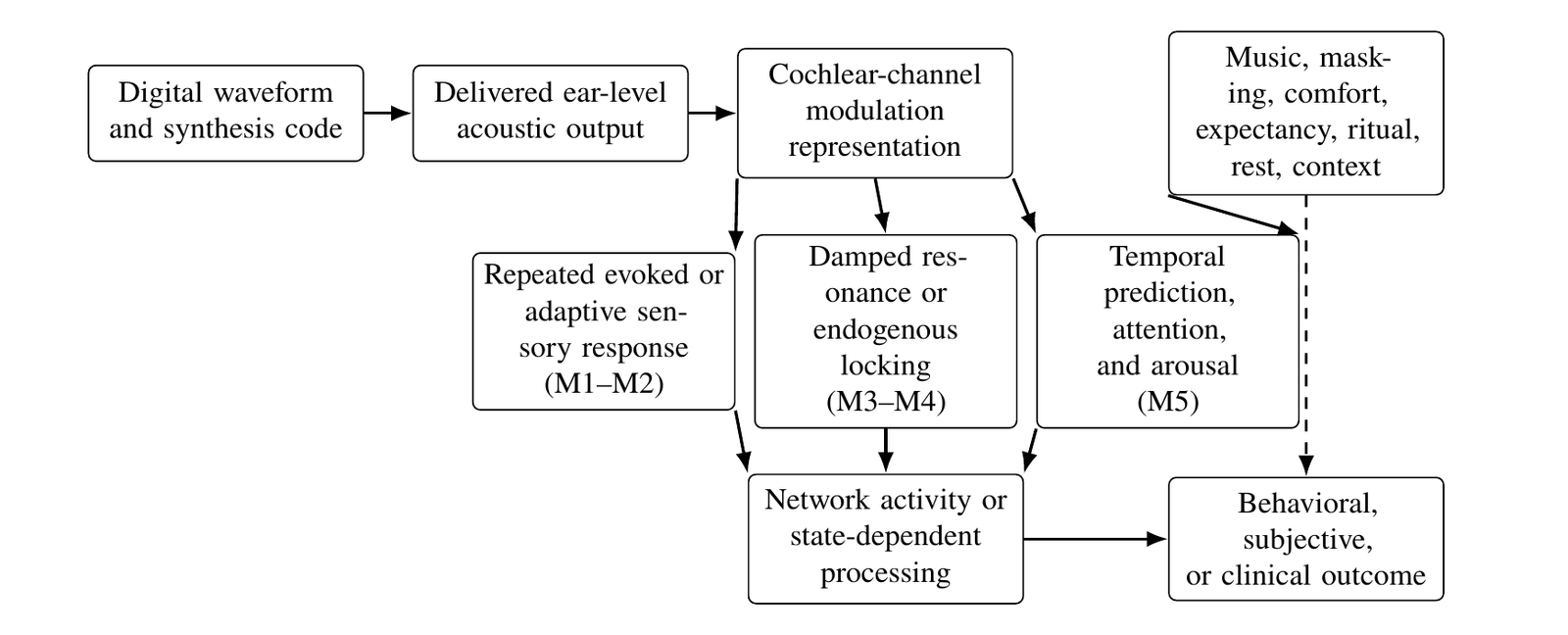
4.1 Estimands determine what a control can establish
| Estimand | Minimum informative contrast | What it identifies | Licensed wording |
|---|---|---|---|
| Total package effect | Complete intervention vs no intervention or usual care. | Combined effect of sound, setting, expectation, rest, device ritual, and all components. | “The package changed outcome X.” |
| Listening-context effect | Active listening vs silence/rest with comparable measurement and contact. | Added effect of listening, but not the pulse component. | “Listening under this protocol changed X.” |
| Incremental isochronic-component effect | Identical music/noise and procedure with vs without pulses. | Added value of the pulse component as implemented. | “Adding the pulses changed/did not detectably change X.” |
| Regularity effect | Regular vs irregular or phase-scrambled events matched for level, event count, onset energy, and modulation power where possible. | Consequence of temporal predictability or regularity. | “Regular timing changed X relative to the matched irregular control.” |
| Target-frequency effect | Target rate vs adjacent rates or individualized detuning, with other acoustic features controlled. | Frequency selectivity beyond generic periodic stimulation. | “The effect depended on drive frequency.” |
| Neural mediation effect | Randomized manipulation, online neural engagement, outcome, and prespecified mediation or instrumental analysis. | Whether the measured neural change lies on the causal path to outcome. | “The treatment effect was mediated by neural measure M,” subject to assumptions. |
No single control answers all of these questions. A music-only control is strong for the incremental pulse effect but does not isolate regularity. A jittered control isolates some timing properties but may differ in modulation spectrum, salience, predictability, and onset history. A silent control estimates the total listening effect but is weak for component attribution.
5 Direct and Near-Direct Human Evidence
5.1 Corpus structure
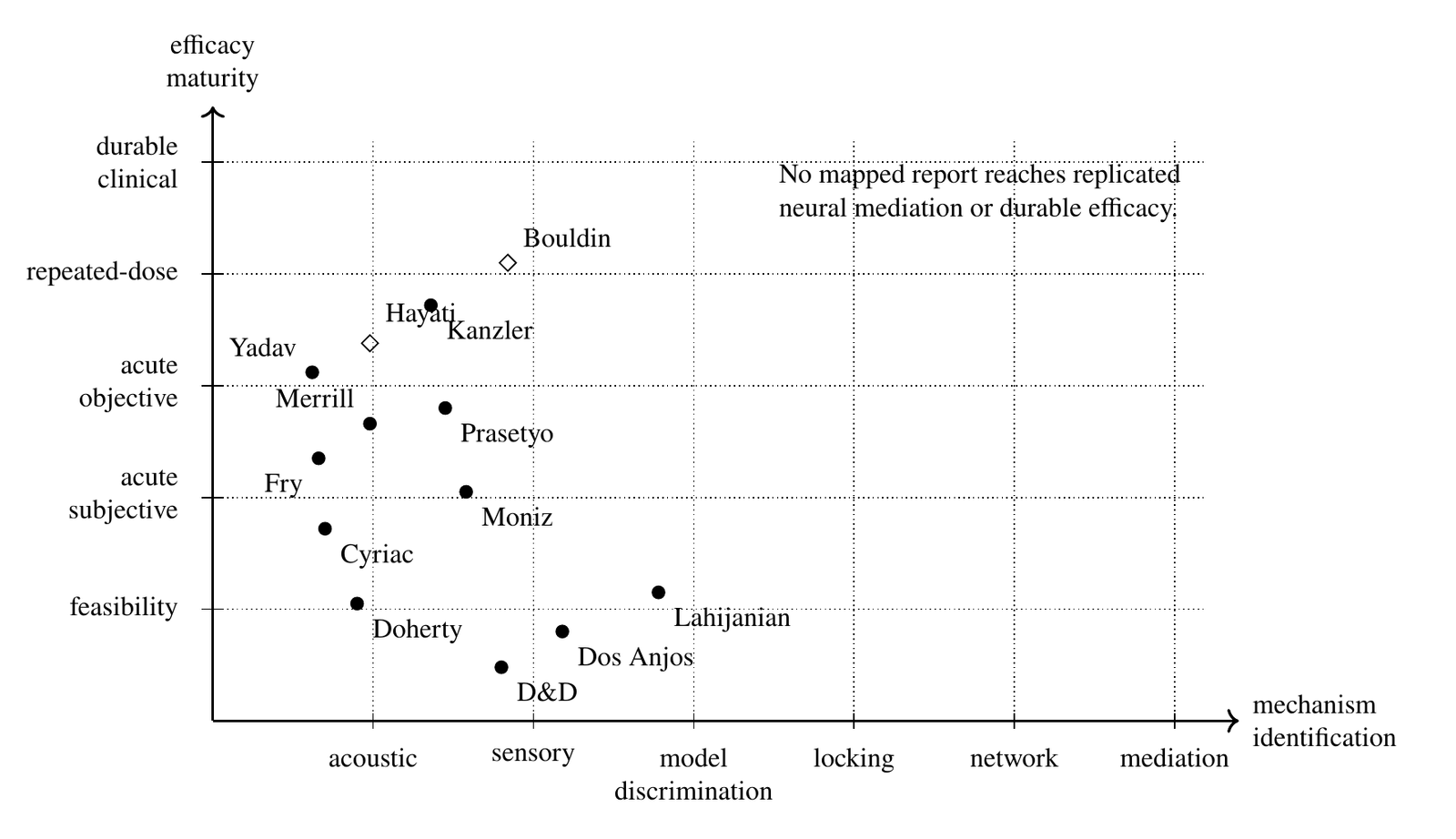
The mapped corpus is small, design-heterogeneous, and concentrated in pilot, thesis, small-journal, or multicomponent studies. It contains classic and embedded tones, derived device patterns, mixed packages, and precisely pulsed auditory gamma paradigms. One publication is an explicit reanalysis of a prior dataset [44, 45]. Several reports do not provide enough acoustic detail to recreate the intervention, and few combine online neural measurement with a strong active control and a prespecified behavioral outcome.
The evidence map in Figure 2 separates mechanism identification from efficacy maturity. Placement is qualitative and represents the strongest inference licensed by the report, not a numerical score.
| Report | Class | Design / population | Stimulus and comparison | Neural measure | Outcome | Main concerns | Licensed inference |
|---|---|---|---|---|---|---|---|
| Doherty (2014) [46] | A2 | Undergraduate thesis; acute exposure | 10 Hz tone alone vs same tone embedded in music; no true pulse-absent active control | Limited EEG; weak alpha evidence | Comfort and affect ratings | No adequate component control; sparse spectral/phase methods; stimulus output not audited | Music can improve tolerability of an otherwise salient pulsed tone; alpha capture not established |
| Deraman (2015) [22] | A/B, indeterminate | Thesis; full text not available to this review | Pure and embedded beta/gamma binaural and isochronic conditions | Abstract-level EEG claims | Alertness/attention framing | Incomplete record; possible overlap with 2017 report; waveform not reconstructable | Historical/provisional evidence only |
| Deraman & David (2017) [23] | A1, partly indeterminate | Acute comparison; 10 healthy men; four frontal channels | 40 Hz isochronic vs 40 Hz binaural stimulation | Frontal/anterior-frontal RMS amplitude | No behavioral outcome | Consumer EEG; RMS not isolated 40 Hz response; online audio; no artifact or irregular control | Physical pulsing produced a stronger measured frontal response than the binaural condition under this setup |
| Cyriac et al. (2016) [47] | A1/D | Small post-exercise physiological study | 60 or 160 BPM pulse/metronome-like audio vs white noise | None | Heart rate, blood pressure, respiration recovery | Small sample; no EEG; tempo-like rather than state-specific neural test | No detected differential autonomic recovery in this context |
| Moniz-Lewis & Frederick (2020) [48] | A2 | Between-group study; 60 undergraduates | Music plus 8 Hz pulses vs identical music without pulses | Short consumer-EEG recordings; alpha power | Perceived stress | Limited EEG validity; short exposure; no equivalence test | No evidence that adding the 8 Hz component reduced stress more than music; predicted alpha increase was not observed |
| Fry et al. (2021) [49] | A2/C | Pilot study in trained cyclists | Self-selected music with or without 40 Hz isochronic beats; separate vibrotactile condition | None | Cycling performance, arousal, affect | Narrow context; no neural engagement measure; pilot precision | No evidence of incremental performance or affect benefit from the added 40 Hz component in this protocol |
| Yadav et al. (2021) [50] | C | Teen wellbeing intervention with multiple groups/components | Brainwave-entrainment audio containing binaural and isochronic elements, Heartfulness meditation, and combinations | None reported for component mechanism | Mental wellbeing measures | Isochronic component not isolated; meditation and package effects; expectancy/blinding challenges | Evidence pertains to a multicomponent wellbeing program, not to isochronic frequency-specific efficacy |
| Merrill & Amin (2021) [51] | A2/C | Uncontrolled chronic-pain pilot | Rhythmically enhanced music containing isochronic theta beats | None | Pain and medication use | No music-only or sham-rhythm control; conference-level report; regression and expectancy plausible | Feasibility signal for the package; entrainment attribution impossible |
| Kanzler et al. (2023) [44] | B/C | Four-arm randomized repeated-use study in healthy workers; 20 min/day for 21 days | White noise, binaural, isochronic, or combined acoustic neurostimulation; dynamic beta–alpha–beta protocol | Multiple EEG outcomes | DASS-21, sleep quality, salivary cortisol | Complex/proprietary package; many comparisons; no clean fixed-10-Hz estimand; limited blinding evidence | Repeated acoustic-neurostimulation packages produced some self-report signals; fixed-alpha isochronic causation not identified |
| Bouldin et al. (2024) [45] | B/C | Secondary PCA reanalysis of Kanzler dataset | Same intervention and participants | No new measurements | Multivariate interpretation | Not independent replication; data-driven component interpretation | Suggests non-additivity within the original dataset; adds no independent efficacy evidence |
| Dos Anjos et al. (2024) [52] | B | Within-participant EEG comparison | Derived 50 Hz isochronic pattern vs 50 Hz binaural beats and white noise | Spectral power and connectivity measures | Subjective ratings; no primary behavioral efficacy endpoint | Derived rather than classic waveform; 50 Hz line-noise risk; common-drive/source-leakage concerns | Different auditory classes produced different EEG patterns; endogenous gamma capture and functional communication remain unresolved |
| Lahijanian et al. (2024) [53] | D, near-direct | Acute EEG in 33 older participants spanning normal cognition, MCI, and dementia | 5 kHz carrier, 40 Hz rectangular modulation, 4% duty cycle; stimulation vs rest | 40 Hz peak-based score, PLV, source/connectivity analyses | No randomized clinical efficacy outcome | Repeated-evoked and common-drive models not excluded; rest is not active acoustic control; source/connectivity limits | Strong evidence of stimulus-frequency auditory engagement and heterogeneity under this protocol; not proof of restored DMN communication or treatment efficacy |
| Prasetyo et al. (2025) [54] | A1, indeterminate | School-based group experiment | Alpha, beta, or gamma labelled isochronic audio vs silent/mute control | None | Sustained-attention/concentration score | Baseline imbalance; weak control; underreported stimulus; no multiplicity or mechanism test | Hypothesis-generating evidence of post-exposure score differences; frequency-specific causal attribution is very weak |
| Hayati et al. (2026) [24] | A1, provisional | Abstract/bibliographic-level repeated-dose report in 120 dental students | 40 Hz isochronic exposure, 10 or 30 min/day, vs control | None reported | Depression, anxiety, and stress scales | Full methods, control audio, attrition, effect estimates, adverse events, and publication record not fully verifiable during review | Provisional applied signal; excluded from strong mechanistic or clinical inference until full verification |
5.2 What the direct corpus supports
First, physically pulsed auditory stimulation can be a strong sensory driver. This conclusion is biologically expected and is supported most directly by the stronger measured response to isochronic than binaural stimulation in Deraman and David, as well as by the near-direct EEG studies [23, 52, 53]. The claim should remain at the level of auditory engagement unless stricter models are tested.
Second, stimulus classes can produce distinguishable scalp-EEG patterns. Dos Anjos et al. found differences among derived isochronic, binaural, and white-noise conditions, while Lahijanian et al. observed a prominent 40 Hz response and related phase measures [52, 53]. These findings justify mechanistic study, but they do not by themselves discriminate a train of evoked responses from a damped resonator or self-sustained oscillator.
The broader ASSR literature supplies both stronger physiological anchors and stronger null models. Source-localization and temporal-integration studies map distributed auditory generators and response build-up [55, 56]. Convolution and deconvolution studies show that much of the steady response can be reconstructed from rate-dependent transient activity, with the largest mismatches concentrated around onset or other nonstationarities [57, 58, 59]. Human and translational pharmacology indicate that inhibitory and NMDA-dependent circuit state shapes the 40 Hz ASSR, while recent preclinical work reports partial pharmacological dissociation between transient auditory evoked responses and the ASSR [37, 38, 60]. These findings support genuine neural-circuit involvement, but circuit involvement is not identical to autonomous phase locking.
Third, adding pulses to a plausible listening experience has not consistently improved applied outcomes. The music-matched studies by Moniz-Lewis and Frederick and by Fry et al. did not provide evidence of an incremental benefit of the isochronic component in their respective stress and exercise-performance contexts [48, 49]. Their nulls are important because the comparator isolates a consumer-relevant component effect more cleanly than silence does. They are not equivalence demonstrations and do not exclude effects outside the tested protocols.
Fourth, repeated multicomponent protocols produce signals worth testing but do not identify a frequency-specific mechanism. Kanzler et al. is the most information-rich repeated-use study, yet its dynamic acoustic-neurostimulation package, multiple active components, broad outcomes, and exploratory EEG analyses prevent a clean inference about fixed 10 Hz alpha entrainment [44]. Bouldin et al. reanalyzes the same data and must not be counted as replication [45].
Fifth, evidence for durable clinical benefit, neural mediation, and safety is not mature. No mapped dataset provides independent replicated clinical efficacy with exact stimulus reconstruction, credible component controls, online neural engagement, prespecified mediation, systematic harms collection, and follow-up.
5.3 Study-specific inferential boundaries
5.3.1 Lahijanian et al.: engagement is not yet network restoration
The 40 Hz auditory protocol is well specified relative to most of the corpus and the study shows a clear stimulus-frequency response. Nevertheless, the “entrainment score” is based on the sharpness of the 40 Hz spectral peak relative to neighboring bins, a quantity that can increase under exact periodic forcing without autonomous oscillator capture. PLV at the drive frequency can also rise when channels share a strong stimulus-locked source, when signal-to-noise ratio increases, or when volume conduction and source leakage are present. Correlation between a peak-based response index and PLV may therefore reflect a shared dependence on the same 40 Hz driven signal rather than an independent bridge from local entrainment to restored communication. The strongest defensible wording is auditory engagement with stimulus-linked phase structure and participant heterogeneity, not demonstrated restoration of default-mode-network communication.
5.3.2 Dos Anjos et al.: derived stimulation and the special problem of 50 Hz
The within-participant comparison is valuable because it contrasts auditory classes under the same recording design. Its derived alternating-tone pattern should remain visibly distinct from a classic gated carrier. Moreover, 50 Hz is a mains frequency in many environments. Any target-frequency power or connectivity claim at 50 Hz requires unusually strong evidence against line contamination, harmonics, equipment coupling, EMG, filter leakage, and unequal signal-to-noise ratios. Connectivity changes at the driven frequency should not be interpreted as increased communication without source-space, common-drive, leakage, and local-power controls.
5.3.3 Kanzler and Bouldin: package effects and shared data
The clinically attractive outcomes in Kanzler et al. occur within a dynamic protocol containing white noise and transitions across nominal frequency ranges. The randomized arms make the study more informative than an uncontrolled pre/post design, but they do not reduce the intervention to “10 Hz isochronic tones.” The paper estimates effects of particular acoustic-neurostimulation packages and between-package differences. Bouldin et al. contributes a multivariate view of the same observations, not independent confirmation.
5.3.4 Controlled nulls: interpret absence of evidence precisely
Moniz-Lewis and Frederick and Fry et al. are valuable because they ask whether pulses add value beyond music. Their nonsignificant results should be described as a failure to detect an incremental effect, not proof that the true effect is exactly zero. Future replications should prespecify a smallest effect size of interest and use equivalence testing or Bayesian model comparison. A clean, precise null can be more informative than a positive uncontrolled change.
6 The Isochronic Entrainment Discrimination Framework
The framework treats mechanistic interpretation as comparison among candidate data-generating processes. A significant target-frequency peak is not a model. The central question is which model predicts responses to new frequencies, levels, histories, omissions, and offsets.
6.1 Candidate generative models
Let pulse onsets occur at times and let denote the delivered acoustic input after measurement at the ear. The following models are not mutually exclusive; mixtures may be required.
| Model | Core idea | Predictions | Critical tests |
|---|---|---|---|
| M0: equipment or analysis artifact | The periodic feature is produced by electrical leakage, vibration, trigger coupling, line noise, filtering, or analysis choices. | May have implausibly short latency, fixed phase to hardware, persistence in phantom channels, dependence on cable geometry, or survival when acoustics are blocked. | Phantom/head-model recordings; disconnected transducer; acoustic-only microphone channel; cable/headphone substitutions; line-frequency controls; pipeline simulations. |
| M1: unrestricted linear convolution | , or for pulse events. The kernel is phenomenological unless constrained in advance. | A regular-train response, its harmonics, and stimulus-fixed phase are predictable from ; a sufficiently flexible can contain oscillatory ringing. | Estimate from persistently exciting irregular input and predict held-out rates, histories, and offsets; preregister any support, smoothness, or non-oscillatory restriction. |
| M2: history-dependent evoked response | with determined by recent intervals, adaptation, refractoriness, habituation, or nonlinear summation. | Response depends on event history and inter-onset interval; departures from linear superposition occur without autonomous oscillation. | Vary recent history, burst length, and irregularity; fit nonlinear state-space or generalized convolution models; test held-out histories. |
| M3: structured damped resonator | A low-dimensional stable resonant system has a preferred frequency and rings after perturbation but is not self-sustaining. As an input–output map it is nested within unrestricted M1. | A parsimonious oscillatory impulse response, frequency selectivity, gradual build-up, damped offset ringing, and detuning-dependent phase lag. | Compare restricted candidate classes under chirps, multisines, impulses, and amplitude steps; evidence for the parameterization is not by itself proof of a distinct biological generator. |
| M4: endogenous oscillator locking | A self-sustained oscillator is pulled or locked by forcing. A reduced phase model can be written . | Detuning-by-intensity “Arnold tongue,” phase pulling, phase slips near locking boundaries, dependence on intrinsic frequency, and autonomous dynamics after perturbation. | Multiple frequencies around a local intrinsic rhythm, multiple intensities, phase-slip analysis, perturbation response, preregistered locking-region prediction. |
| M5: temporal prediction | The brain learns when events are likely and allocates attention or expectation accordingly. | Omission responses, task and attention dependence, hazard-related effects, behavioral phase modulation, and sensitivity to predictability beyond spectral power. | Rare omissions, local irregularities, predictable vs unpredictable sequences, task relevance manipulations, phase-specific behavior. |
| M6: nonspecific listening-package effect | Outcomes arise from pleasantness, music, masking, relaxation, expectancy, demand, novelty, or structured rest. | Behavioral benefit may occur without target-frequency neural engagement and may track expectancy or comfort more strongly than rate. | Factorial component isolation, expectancy manipulation, credible active controls, mediation by nonspecific variables, blinded condition guessing. |
The model classes are partly nested rather than mutually exclusive. In particular, a stable linear damped resonator has an impulse response and is therefore exactly representable by unrestricted M1. M3 becomes a distinct statistical candidate only when M1 is constrained or when the comparison concerns parsimony and parameter invariance rather than raw fit. Rejecting a restricted M1 is still not sufficient to accept M4: adaptation, refractoriness, nonlinear summation, predictive timing, and artifacts can all produce departures from simple superposition. A credible entrainment claim therefore requires prespecified model classes, recovery analysis, and held-out perturbations.
6.2 Identifiability is relative to model, design, measurement, and summary
Let denote an internal mechanism, the delivered input, the measured signal, the acquisition and analysis operator, and the reported summary. The inferential chain is
For a design that includes the input, sensor, preprocessing, and summary, two mechanisms are observationally equivalent when
An experiment then identifies an equivalence class, not necessarily a unique biological mechanism. This is the relevant connection to structural identifiability and realization theory: different parameterizations or internal state descriptions can share the same observable input–output law, and state coordinates are not themselves biological identities [61, 62, 63].
Three failures should be distinguished. Model-class or structural non-identifiability occurs when candidate classes generate the same possible input–output laws, as when stable linear M3 is contained in unrestricted M1. Input-specific non-identifiability occurs when classes differ under some perturbations but not under the input actually used, as with exact regular forcing. Practical non-identifiability occurs when a distinction exists mathematically but is too weak relative to finite duration, noise, sensor mixing, preprocessing, or between-person variability. Persistently exciting inputs address the second failure, not automatically the first or third [64, 65].
The same logic exposes two information bottlenecks. A highly symmetric input may fail to excite discriminating directions, and a scalar summary may discard information present in the full waveform. For deterministic , the data-processing inequality gives
A target-frequency power or phase statistic therefore cannot recover mechanistic information that the design did not generate, and can lose information that the raw measurement did contain.
6.3 Predictive model comparison
The decisive standard is predictive performance, not the number of significant contrasts. Candidate models should be fit on an identification set and evaluated on held-out conditions using cross-validated likelihood, posterior predictive checks, information criteria suited to the modeling framework, and simulation-based parameter-recovery tests. The analysis plan should specify the data features each model must predict: waveform-level EEG, spectral shape, harmonics, phase trajectories, onset transients, omission responses, post-offset dynamics, and behavior. Flexible models should be penalized for complexity and all preprocessing steps should be included in recovery simulations, because filtering and time-frequency transforms can create apparent persistence or phase structure [66, 67].
6.4 Isochronic stimulation as system identification
Periodic input is a poor identification signal when all candidate models predict periodic output. A stronger program uses temporally rich inputs to estimate the system before asking what a regular train does. Stage 1 should present pseudorandom pulse sequences, controlled inter-onset intervals, chirps, multisine modulation, amplitude steps, omissions, and brief bursts. Auditory chirps, deconvolution, and temporal-response-function methods already provide practical tools for estimating rate dependence and response kernels from richer inputs [68, 55, 57, 58, 69, 59]. These inputs estimate impulse responses, adaptation time constants, nonlinear history dependence, modulation transfer, resonance width, and participant-specific dynamical parameters. Random-phase multisines with deliberately unexcited detection lines offer an especially efficient preliminary audit: a linear time-invariant system cannot transfer energy to unexcited frequencies, whereas harmonics and intermodulation products reveal nonlinear distortion before a particular nonlinear biological model is selected [70]. Stage 2 then asks each fitted model to predict responses to regular trains, adjacent rates, different intensities, and stimulus offset. This is standard system-identification logic applied to auditory neuroscience [71].
Exact regularity creates a symmetry–information trade-off. The same translation symmetry that permits coherent averaging into a clean frequency tag collapses the number of distinct temporal histories presented to the system. Regular stimulation can therefore be excellent for detection and poor for identification. Irregularity is not intrinsically superior for every purpose; it is valuable when it breaks a symmetry that makes the candidate mechanisms observationally equivalent.
Input design should ultimately target the scientific decision rather than a generic matrix criterion. A model-discriminating objective can be written
subject to event-count, exposure, salience, duration, and perceptual constraints. Bayesian and sequential optimal experimental design provide machinery for choosing later perturbations in light of earlier observations [72, 73]. The schedule supplied in the computational companion is narrower: it is the best ridge-log-determinant candidate among 500 constrained schedules for estimating a 40-parameter linear FIR kernel. It is neither a proven global optimum nor automatically optimal for model discrimination, comfort, safety, or behavioral efficacy.
Related perturbation studies illustrate why both negative and positive tests are required. A transient-superposition model can reconstruct a steady visual response [25], whereas detuning, intensity, and phase-slip tests can provide evidence not captured by that simple null [26]. In audition, chirp sweeps, build-up dynamics, and disruptive probes offer complementary ways to test rate preference, temporal integration, and recovery [68, 56, 74].
A genuine mechanistic advance would be an out-of-sample result such as: an individual’s response to irregular identification sequences predicts the frequency–intensity region in which phase slips disappear during regular stimulation, and experimentally entering that region changes a prespecified behavior. A peak observed only after selecting a target frequency is much weaker evidence.
7 Analytic and Computational Identifiability Results
7.1 Scope, code, and inferential status
The following results ask what can be learned from exact digital stimuli and observed time series before new biological data are collected. They combine algebraic identifiability statements with deterministic synthetic counterexamples, model-recovery tests, input-design optimization, acoustic Fourier analysis, and preprocessing simulations. All numerical results were generated by the accompanying Python program with a fixed seed (20260714), and all tables, figures, schedules, and digital reference stimuli are included in the computational companion. These analyses establish logical limitations and testable design consequences. They do not establish which model generated an existing human EEG dataset, the prevalence of any mechanism, or clinical efficacy.
7.2 Periodic forcing guarantees periodic output in every stable linear model
Proposition 1 (Periodic-output non-identifiability)
Let be a bi-infinite -periodic input and let be the impulse response of a stable discrete-time linear time-invariant system. Its zero-state periodic steady-state response is -periodic. A causal realization with an arbitrary initial state approaches this response as its homogeneous component decays; the transient need not vanish after a finite number of samples. Consequently, a Fourier transform of the steady-state response over an integer number of periods contains lines only at harmonics of the input period, regardless of whether is interpreted as an evoked transient, an auditory filter, or a damped resonator.
Proof. Absolute summability permits rearrangement of the steady-state convolution. For every ,
The harmonic statement follows from the discrete Fourier representation of a periodic sequence. Stability makes the separate homogeneous initial-condition contribution decay asymptotically.
The proposition makes a target-frequency peak a predicted consequence of exact periodic forcing under an extremely broad null. It also applies to high across-trial phase consistency when trials share the same stimulus timing. Neither observation identifies the generating mechanism.
7.3 A linear damped resonator is nested inside an unrestricted evoked kernel
Proposition 2 (Linear-resonator nesting)
Consider the stable underdamped system
Its zero-state output is a convolution with
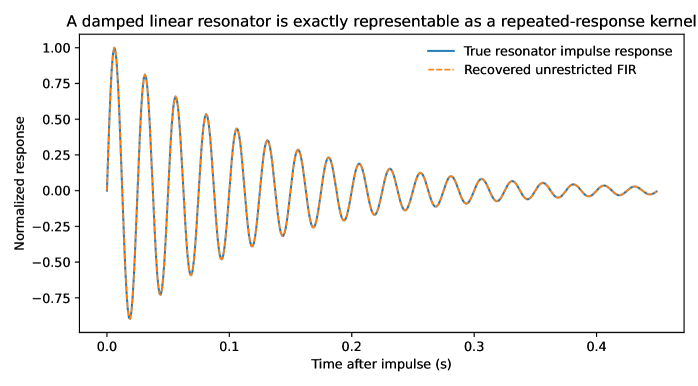
Therefore every stable linear damped-resonator input–output law is a special case of M1 whenever M1 permits an unrestricted kernel .
Proof. The displayed is the Green function obtained by applying a unit impulse to the linear differential equation. Superposition and time invariance then give for every admissible input.
This has a direct methodological consequence: input–output fit cannot prove that M3 is biologically distinct from M1 when M1 is unrestricted. With a nonzero initial state, the resonator output is , where the homogeneous component decays under stability; the proposition is therefore an exact zero-state input–output equivalence, not an assertion that every internal-state interpretation is identical. A resonator may be preferred because it is lower-dimensional, predicts a transferable parameterization, or agrees with independent physiology; that is evidence for parsimony or interpretation, not structural separation. A synthetic recovery test made the point numerically. An unrestricted 450-lag FIR kernel estimated from an irregular input recovered the damped-resonator impulse response with correlation greater than 0.999999999999 and predicted a held-out regular 40 Hz train with (Figure 3).
7.4 Exact periodicity creates a circular rank ceiling and causal ill-conditioning
Proposition 3 (Circular rank ceiling of a periodic pulse comb)
Let and let when and zero otherwise. The circular-convolution matrix generated by has rank . A circular FIR design formed from any shifts of this input therefore has rank at most .
Proof. A circulant matrix is diagonalized by the -point discrete Fourier transform. The transform of the pulse comb is
which equals when is a multiple of and zero otherwise. Exactly eigenvalues are nonzero, so the circulant rank is ; selecting shifted columns cannot increase rank beyond .
Proposition 4 (Finite causal boundaries restore rank but not balanced information)
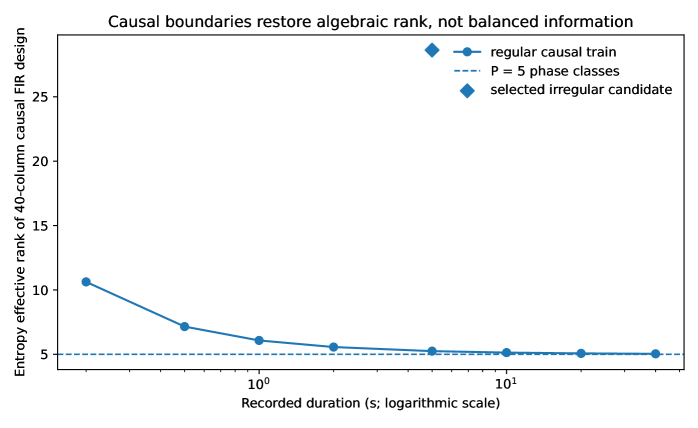
Let for with , let for , and define the causal FIR matrix by . If , then has algebraic rank . For fixed and ,
Thus at most Gram-matrix eigenvalues grow linearly with record length, while the remaining directions, when , are supported principally by the finite boundaries and remain . The causal design can be full rank and nevertheless become increasingly ill-conditioned as the periodic interior grows.
Proof. The first block of is lower triangular with unit diagonal because and for , so . After the finite onset region, rows recur in at most phase classes. Summing their outer products gives plus a boundary and incomplete-period remainder with uniformly bounded norm. Since is a sum of at most phase-class outer products, its rank is at most . Eigenvalue perturbation then bounds the remaining Gram eigenvalues by while at least one leading eigenvalue is .
This distinction separates algebraic from practical identifiability. The circular five-second benchmark, which represents a steady-state periodic design, had rank and effective rank 5 for a regular 40 Hz train and rank 40 with effective rank 28.47 for the selected irregular schedule. In the more conventional finite causal construction, both five-second, 40-column designs had algebraic rank 40. Their information geometry was nevertheless very different: the regular train had effective rank 5.247 and unregularized design-matrix condition number 77.51, versus 28.624 and 6.69 for the selected irregular candidate. Extending the regular record from 5 to 40 seconds drove effective rank from 5.247 to 5.039, toward the five long-run phase classes rather than toward 40 balanced dimensions.
Here effective rank is the entropy effective rank of the positive eigenvalues of ,
It equals algebraic rank only when the nonzero information directions are equally weighted. The selected schedule was the highest ridge-stabilized log-determinant among 500 constrained same-event-count candidates with 10–40 ms gaps. It is supplied as a machine-readable identification input, not claimed as a global optimum or as a perceptually matched clinical control.
7.5 Target-frequency power and phase consistency are constructively non-diagnostic
Four synthetic generators were exposed to the same regular 40 Hz pulse train: a non-oscillatory linear evoked kernel, a history-dependent adaptive evoked model, a stable damped resonator, and a pulse-coupled autonomous phase oscillator. Each deterministic 40 Hz component was normalized to equal Fourier amplitude, mixed with equal autoregressive noise, and evaluated over 160 trials. All four produced a median target-bin SNR between 26.43 and 26.84 dB, target power fractions between 0.396 and 0.399 over 1–100 Hz, and phase consistency at 40 Hz of at least 0.9996 (Figure 5). The values were deliberately matched to construct a counterexample: a peak and high phase consistency can be nearly identical even when the generating equations are incompatible.
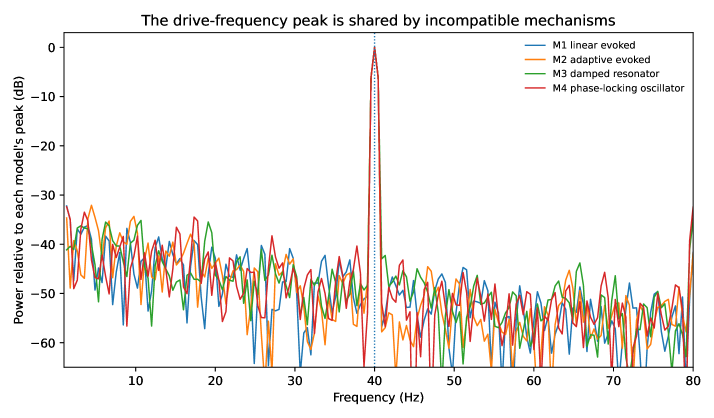
Irregular histories become useful when the alternatives are genuinely non-nested. In the principal adaptive simulation, an unrestricted linear FIR fitted on irregular events achieved only on a held-out regular train, while the correctly specified two-parameter adaptation model recovered the generating values ( s, depletion ) and achieved . Across a 25-cell robustness grid, linear held-out ranged from 0.147 to 0.998: weak or rapidly recovering adaptation can be practically indistinguishable from linearity, whereas strong, slow adaptation is detectable. Thus model failure is itself dose- and timescale-dependent.
7.6 What autonomous locking predicts beyond phase concentration
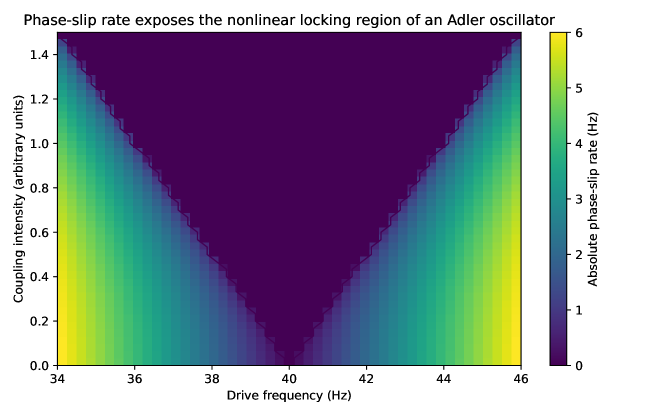
For the reduced phase equation
a stable phase-locked solution exists only when . Outside this interval, the deterministic phase-slip rate is cycles/s. The resulting detuning-by-intensity boundary is the qualitative signature shown in Figure 6. Phase concentration at one selected rate does not test this prediction; a locking claim should predict the boundary, phase lag, and slips on held-out combinations.
A complementary positive test is a phase-response relation. If the system possesses a meaningful autonomous phase variable, a weak perturbation delivered at phase should produce a reproducible shift
where is a phase-response curve. An independently estimated should predict preferred locking phase, susceptibility to different waveforms, and the edges of the locking region [75]. In scalp EEG this test is demanding because sensor phase can mix sources and becomes unstable at low amplitude; those difficulties are reasons to validate the phase variable, not reasons to replace the test with target power.
7.7 Implication for the framework
The candidate list should be treated as a partially ordered and compositional set of model classes, not seven mutually exclusive boxes. M3 lies inside unrestricted M1; M1 is a limiting case of several history-dependent models; and a measured neural signal may contain additive or interacting artifact, evoked, adaptive, predictive, resonant, and oscillatory components,
M6 is different in kind: it is a parallel causal pathway from the listening experience to behavior and may coexist with any neural generator. Sufficiently flexible nonlinear models can also interpolate finite observations. Mechanistic identification is therefore always relative to prespecified restrictions. The scientifically useful target is not an impossible proof against every conceivable process, but predictive dominance over serious, recoverable alternatives under perturbations chosen to separate them.
8 Acoustic Specification and Control Design
8.1 Audit the delivered signal, not only the source file
The intervention is the pressure waveform at the ear, not the digital file. Headphone equalization, amplifiers, operating-system processing, codecs, clipping, automatic gain control, speaker-room interactions, and transducer nonlinearities can alter sharp pulses and modulation depth. Each study should archive the lossless stimulus and synthesis code, record actual output with an appropriate coupler or microphone, report peak and time-averaged level, and verify that nominally matched conditions are matched at the relevant acoustic representations.
Three representations should be reported:
-
1.
the periodic envelope and its modulation spectrum;
-
2.
the physical acoustic spectrum, including carrier and sidebands;
-
3.
the modulation pattern after an auditory filterbank or cochlear model.
8.2 Rectangular duty cycle determines a harmonic family
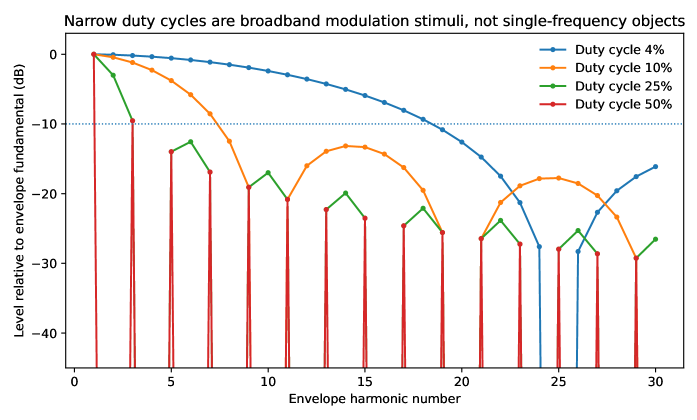
For a unit rectangular envelope of duty cycle , the complex Fourier coefficient at envelope harmonic is
The magnitude relative to the fundamental is . A 40 Hz train with 4% duty cycle therefore has its first envelope null only at harmonic 25, corresponding to 1000 Hz; in the computational audit, 18 of the first 30 harmonics remained within 10 dB of the fundamental. Those envelope components generate sidebands around a tonal carrier and change the cochlear input. Calling such a waveform simply “40 Hz” suppresses most of its acoustic structure (Figure 7).
8.3 An extended audit of envelope, sideband, and auditory-channel structure
A separate nine-waveform audit held the synthesis pipeline explicit and quantified the first 12 envelope harmonics, acoustic sidebands, temporal sharpness, and a transparent three-channel gammatone-like proxy. Within those 12 harmonics, the sharp 40 Hz, 4% duty gate placed 10.1% of energy at the fundamental and 89.9% in harmonics 2–12; its normalized harmonic entropy was 0.994, compared with approximately zero for sinusoidal amplitude modulation. Resetting the carrier phase of an otherwise matched 997 Hz carrier with a 10 Hz, 10% gate changed the first-sideband-pair fraction from 0.194 to 0.077 and the order- sideband fraction from 0.706 to 0.846. Carrier phase continuity is therefore part of the intervention definition rather than an implementation footnote.
In the same deliberately simplified auditory-channel proxy, the target-rate modulation fraction was 0.272 for the sharp 40 Hz gate and 1.000 for sinusoidal amplitude modulation. It changed from 0.310 for a regular 10 Hz pulse train to 0.011 for a matched-event jittered train. These quantities are properties of the declared digital proxy, not measurements of a human cochlea. Their role is to show that temporal controls can differ materially after peripheral-like filtering even when event count or nominal rate is matched. The companion archive includes the synthesis code, tabulated metrics, plots, and short reference waveforms.
8.4 Music and noise controls require temporal auditing
Music and noise are not temporally neutral. Music can contain strong modulation energy near nominal target rates, while adding a gated tone can change loudness, roughness, onset density, spectral centroid, and predictability. A “music-only” control is therefore necessary but not always sufficient. Conditions should be compared on auditory modulation spectrum, event count, onset strength, crest factor, loudness, roughness, bandwidth, temporal predictability, and participant-rated pleasantness and intrusiveness.
8.5 Use a control family
A rigorous mechanism experiment should use multiple controls chosen for distinct estimands:
-
•
identical music or noise without pulses, for the incremental component effect;
-
•
irregular pulses matched for event count, level, and onset energy, for regularity;
-
•
phase-scrambled or surrogate envelopes preserving selected modulation statistics;
-
•
adjacent regular frequencies, for frequency selectivity;
-
•
the same rate with a different carrier, for carrier dependence;
-
•
sinusoidal amplitude modulation matched at the fundamental, for harmonic and transient structure;
-
•
matched transients with altered long-range regularity, for evoked-response versus prediction tests;
-
•
silence or passive rest, where the total listening effect is scientifically relevant.
Perfect perceptual blinding may be impossible when sharp pulses are salient. Rather than claiming blinding reflexively, studies should report condition guesses, confidence, expectancy, perceived intensity, pleasantness, annoyance, and prior beliefs. Those measurements are potential mediators and moderators, not administrative details.
9 EEG/MEG Inference: From Frequency Peaks to Mechanisms
9.1 Artifact taxonomy
A periodic scalp feature may arise from the brain, the auditory periphery, muscles, equipment, or the analysis pipeline. Minimum artifact consideration should include:
-
•
Equipment and physical pathways: electromagnetic leakage from transducers or cables, shared clocks, trigger leakage, electrode or lead vibration, ground/reference contamination, and room mains noise.
-
•
Peripheral and physiological pathways: cochlear microphonic or other peripheral potentials, facial/scalp/jaw/neck muscle activity, auricular muscle responses, eye movements, and microsaccadic spike potentials.
-
•
Analysis pathways: filter ringing, edge effects, temporal smearing, spectral leakage, harmonics, reference choice, unequal trial counts, power-dependent phase reliability, circular analysis, and uncorrected multiplicity.
High-frequency scalp EEG is especially vulnerable to cranial and ocular muscle contamination, including microsaccadic spike potentials that can mimic gamma activity [76, 77, 78]. Target frequencies near 50 or 60 Hz require explicit mains-frequency controls. A hardware or phantom test should reproduce the full stimulus and acquisition chain without a biological participant. Absence of a visible artifact in ordinary data is not equivalent to a successful exclusion test.
9.2 A target-frequency peak is an observation, not an explanation
Exact periodic stimulation makes a target-frequency peak expected under M0–M4. The peak can establish stimulus-frequency coupling after artifact controls, but mechanism requires additional perturbations. Harmonic structure should be predicted from the envelope and transient waveform before being attributed to neural nonlinearities. Periodic and aperiodic components should be separated where appropriate, but spectral parameterization alone cannot distinguish evoked activity from entrainment [79].
For 10 Hz claims, source and function are central. A scalp response to 10 Hz auditory pulses may be auditory steady-state activity and should not be called posterior alpha modulation without topographic/source evidence, appropriate baselines, and a task relation. For 40 Hz claims, robust auditory engagement is plausible, but gamma-band numerical identity is not evidence of the same circuit state invoked in cognition or disease models.
9.3 A computational demonstration of filtering-extended persistence
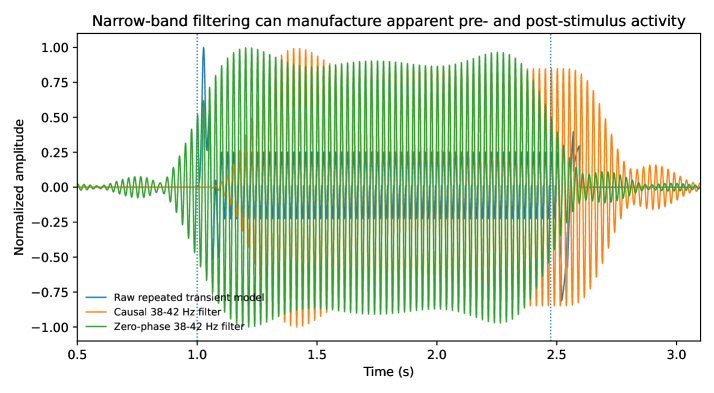
A synthetic repeated-evoked signal was generated by convolving a finite 120-ms non-oscillatory kernel with a 40 Hz event train. A fourth-order Butterworth 38–42 Hz band-pass was then applied forward and backward. At a 10% amplitude threshold, the zero-phase output became visible 113 ms before stimulus onset and remained visible 264 ms after the last pulse, compared with no pre-onset extension and approximately 119 ms of unfiltered kernel duration. Across filter orders 2, 4, and 6 and bandwidths 2–16 Hz, apparent post-pulse duration ranged from 133 to 278 ms. The exact values are pipeline-specific; the general point is that persistence must be benchmarked against the complete analysis operator (Figure 8). Filter choice, direction, bandwidth, and edge handling should therefore be justified by the scientific estimand and checked through impulse-response simulations [66, 80].
9.4 Phase metrics and connectivity
ITPC and PLV quantify consistency, not origin. They increase with stronger evoked responses, higher signal-to-noise ratio, common stimulus drive, and some forms of volume conduction. Sensor-level coherence or PLV between distant electrodes at the drive frequency can therefore increase even when no communication between the underlying regions has changed.
Connectivity claims should include realistic source modeling, leakage-aware estimators, controls for local power and signal-to-noise ratio, separation of evoked and induced components, explicit common-drive models, and simulations showing what a limited auditory source would produce at the sensors [81, 82, 83, 84]. Non-zero-lag measures may reduce some instantaneous mixing but do not solve all confounding. A network label such as “default mode” should not be assigned from coarse scalp topography without spatially adequate evidence.
9.5 Persistence and omissions are informative but not unique
Post-offset activity can reflect a damped resonator, adaptation recovery, endogenous oscillation, filter ringing, or time-frequency smearing. Rapid disappearance does not disprove forced locking, and short persistence does not prove it. Offset analyses must include impulse-response and pipeline simulations.
Omission responses are evidence that temporal expectations formed, but they do not uniquely identify autonomous oscillator capture. Prediction models can generate omission responses without M4. Omissions are strongest when combined with detuning, intensity, history, and model-recovery tests.
9.6 Open and reproducible neurophysiology
Acquisition, preprocessing, analysis, and reporting should follow mature community standards such as COBIDAS-MEEG; data and metadata should be organized in EEG-BIDS or MEG-BIDS-compatible form [85, 86]. The public research object should include raw data, events, channel locations, reference information, exact stimuli, measured output, preprocessing code, model code, preregistration, and a computational environment. Robustness analyses should vary plausible filters, references, artifact decisions, spectral estimators, and source assumptions without creating undisclosed researcher degrees of freedom.
10 Behavioral, Clinical, and Safety Inference
10.1 Mechanism and benefit must be tested in the same causal chain
A behavioral benefit does not become an entrainment effect because the stimulus was labeled alpha or gamma. A mechanistic trial should randomize the acoustic manipulation, measure online neural engagement, and prespecify how that measure is expected to alter behavior. Evidence is strongest when the manipulation changes the neural parameter, the neural parameter predicts outcome within participants, and mediation survives adjustment for expectancy, pleasantness, salience, and baseline state. Even then, treatment randomization alone does not identify a mediator effect; mediator–outcome assumptions and sensitivity to unmeasured confounding should be explicit [87].
A clinically useful listening package need not depend on endogenous entrainment. Music, masking, relaxation, ritual, predictable timing, and attentional disengagement can be legitimate active components. The correct scientific claim would then concern the package rather than a frequency-specific neural command.
10.2 Outcome design and multiplicity
Applied studies should identify one primary outcome and one primary time point, report all prespecified outcomes, provide effect estimates and uncertainty, and distinguish exploratory from confirmatory analyses. Small studies with many EEG bands, electrodes, questionnaires, and time points can generate apparently coherent narratives through multiplicity. Baseline-adjusted models, repeated-measures structure, missing-data assumptions, and attrition should be reported transparently.
Null findings should be designed to be informative. A trial powered only to detect a large effect cannot establish that a small but meaningful effect is absent. Equivalence bounds should be justified in the outcome’s units, and Bayes factors should be accompanied by sensitivity to prior choice.
10.3 Safety and tolerability
The direct literature does not permit a confident safety conclusion. The appropriate statement is:
Adverse-event reporting is too sparse and inconsistent to characterize safety or exclude uncommon harms.
Studies should distinguish spontaneous complaints from systematic elicitation and report calibrated level, duration, cumulative exposure, discomfort, headache, dizziness, nausea, fatigue, tinnitus or hyperacusis exacerbation, sleep disruption, anxiety or agitation, concentration impairment, dropout, and nonadherence. Hearing status and relevant neurological or psychiatric comorbidities should be described. Audio-only evidence should not be generalized to audiovisual flicker or multisensory devices, which have different tolerability and safety profiles.
10.4 Individual differences, reliability, and dose
Heterogeneity should be modeled prospectively rather than converted into post hoc “responder” stories. Candidate moderators include hearing thresholds, age, baseline spectral properties, local intrinsic frequency, attention, task state, sleep pressure, medication, anatomy, temporal acuity, and stimulus tolerance. Proxies such as spontaneous eye-blink rate should be described as proxies rather than direct dopamine measures [88, 89].
Before personalization, the response metric itself must be reliable. Repeated sessions should estimate within-person stability, state dependence, measurement error, and whether apparent responders reproduce. Existing work shows that reliability itself can vary across auditory entrainment measures and conditions [35, 15]. Continuous hierarchical models with shrinkage are preferable to dichotomizing participants after observing outcomes.
Dose is multidimensional:
| (2) |
“Ten minutes at 10 Hz” is therefore not a complete exposure description. Acute EEG engagement, repeated daily listening, all-night stimulation, and phase-locked closed-loop stimulation are different interventions rather than simple durations of one treatment.
11 Claim-Level Synthesis
| Claim | Certainty | Main basis and limitations | Licensed wording |
|---|---|---|---|
| Precisely gated sound can produce a stimulus-frequency auditory response | Moderate | Strong adjacent physiology plus several direct/near-direct EEG observations; artifacts and waveform differences remain important | “Isochronic and related pulse trains can drive measurable auditory responses under some conditions.” |
| Classic isochronic tones capture autonomous endogenous oscillations | Very low | Few detuning-by-intensity tests; no convincing exclusion of adaptive evoked, resonant, predictive, and artifact models | “Endogenous oscillator capture has not been demonstrated robustly for classic isochronic tones.” |
| Target-frequency scalp activity reflects the nominal cognitive band/state | Very low | Frequency-label fallacy; generator, task, and function often unspecified | “A response at the nominal rate should not be equated with alpha, theta, or gamma state induction.” |
| Isochronic stimulation increases functional brain-network communication | Very low | Common drive, source leakage, power/SNR dependence, and spatial limitations dominate current evidence | “Some studies report connectivity metrics during stimulation; network communication remains unresolved.” |
| Adding isochronic pulses improves acute subjective outcomes beyond matched audio | Lowto Very low | Controlled music-matched studies are null; positive studies often use weak or multicomponent controls | “Incremental benefits are inconsistent and protocol-specific.” |
| Isochronic stimulation improves objective cognition or performance | Very low | Small, heterogeneous, underreported studies; no replicated neural–behavioral bridge | “Evidence is hypothesis-generating and does not support general cognitive-enhancement claims.” |
| Repeated use produces durable clinical benefit | Very low | No independent replicated, stimulus-exact, adequately controlled clinical program with follow-up | “Clinical efficacy is not established.” |
| The intervention is safe across populations and doses | Insufficient | Harms rarely collected systematically; uncommon events cannot be estimated | “Safety cannot be characterized from the present literature.” |
The claim most strongly supported is not therapeutic entrainment but experimental tractability. Isochronic stimulation can be synthesized exactly and manipulated along frequency, intensity, duty cycle, edge shape, carrier, predictability, and schedule. That tractability creates an opportunity to make the broader neural-entrainment debate more rigorous.
12 Five Decisive Research Programs
12.1 Mechanistic system-identification study
A dense-EEG or MEG study should use calibrated insert earphones, measured output, individual hearing thresholds, irregular identification sequences, regular trains, multiple neighboring rates, multiple intensities, omissions, and offset probes. Phantom and hardware controls should be run through the full acquisition chain. M0–M5 should be preregistered as generative models, fitted to one subset of conditions, and evaluated on held-out waveform-level and spectral/phase data. The primary endpoint should be model discrimination, not simply target-frequency power.
A public adjacent-data test bed is available in OpenNeuro dataset ds006780 (version 1.0.0). The deposited BIDS ASSR files specify BioSemi acquisition at 512 Hz with 64 channels classified as EEG, plus eight external/EMG channels and one trigger channel, and a 60-Hz power-line frequency; participants.tsv lists 136 participants and 123 ASSR completers [90]. The associated peer-reviewed report describes the acquisition as high-density 70-channel EEG and analyses 114 children (53 with autism spectrum disorder, 35 typically developing, and 26 unaffected siblings) after quality control during an active oddball task using 500-ms binaural 27- and 40-Hz click trains [91]. The deposited, task-complete, and analysed counts therefore refer to successive stages of the study, while the BIDS record and article use different channel-count conventions; the computational pipeline treats the BIDS sidecars as authoritative for file-level acquisition parameters and task availability, and the article as authoritative for the analysed cohort. The companion includes an executable pipeline for target-rate SNR and phase, evoked–induced decomposition, split-half topographic reliability, and cross-rate prediction by a shared click-response kernel. This dataset cannot identify an Arnold tongue or classic-isochronic component efficacy because it lacks a detuning–intensity grid and within-train timing manipulations; its value is method validation and adjacent ASSR model testing.
A decisive M4 result would include a predicted detuning-by-intensity locking region, phase slips near its boundary, participant-specific dependence on an independently estimated intrinsic rhythm, and superior out-of-sample prediction relative to adaptive-evoked and resonator models. A decisive non-M4 result would show that history-dependent evoked models explain the full response without autonomous dynamics.
12.2 Component-isolation factorial trial
A factorial design should manipulate independently: music present/absent, pulses present/absent, regular/irregular timing, target/adjacent frequency, and expectancy framing where ethically appropriate. This design estimates the package effect, music effect, pulse increment, regularity effect, frequency specificity, and expectancy interaction within one coherent experiment. Acoustic features and subjective salience should be measured rather than assumed equal.
12.3 Repeated-dose clinical trial
A clinical trial should enroll a defined population, use concealed allocation and a credible active control, prespecify one primary clinical outcome, collect objective and subjective secondary outcomes, monitor adherence and calibrated exposure, assess adverse events systematically, and include durability follow-up. Neural engagement should be a mechanistic endpoint rather than a surrogate for clinical benefit. Independent replication should precede treatment claims.
12.4 Reliability and heterogeneity study
The same participants should complete multiple sessions to estimate reliability of auditory following, candidate locking parameters, network metrics, and behavioral response. Hierarchical variance decomposition should separate trait, session state, measurement error, and condition effects. A personalization rule should be tested prospectively in a held-out sample rather than derived and evaluated in the same data.
12.5 Adversarial registered report and decisive null
Proponents and skeptics should agree in advance on stimuli, controls, candidate models, preprocessing, smallest effects of interest, decisive outcomes, and interpretation rules. A registered report would reduce selective flexibility and make a high-quality null scientifically valuable. The central decision should be whether the data discriminate models and whether any neural effect produces a clinically or cognitively meaningful increment beyond matched listening context.
13 Minimum Reporting Set for Isochronic Auditory Studies
| Domain | Required information |
|---|---|
| Stimulus object | Carrier waveform/frequency; modulation rate/depth; duty cycle; edge function; carrier-phase behavior; duration; schedule; channel configuration; sample rate/bit depth; lossless file and synthesis code; cryptographic checksum. |
| Delivered acoustics | Headphone/speaker model; calibration method; ear-level peak/RMS/time-averaged level; crest factor; measured output recording; clipping, compression, equalization, and operating-system processing; modulation and acoustic spectra; cochlear/filterbank representation. |
| Controls and blinding | Exact control audio; estimand for each contrast; acoustic matching metrics; condition guesses; expectancy, pleasantness, salience, annoyance, and perceived intensity. |
| Neurophysiology | Hardware/phantom tests; channel montage and reference; event timing; artifact criteria; filters and edge handling; evoked/induced separation; periodic/aperiodic analysis; phase-metric safeguards; source/connectivity assumptions; common-drive and SNR controls; preregistered primary neural endpoint. |
| Behavior and clinical outcomes | Prespecified primary outcome/time point; effect estimate and uncertainty; multiplicity plan; baseline adjustment; missing-data assumptions; adherence; follow-up; clinically meaningful threshold. |
| Safety | Exposure level and cumulative dose; systematic adverse-event elicitation; discomfort, headache, dizziness, tinnitus/hyperacusis, sleep disruption, agitation, fatigue, concentration effects; dropout and nonadherence. |
| Open science | Protocol; registration; deviations; raw data in BIDS-compatible form; exact stimuli; measured output; code; model-recovery simulations; computational environment; full results and exclusions. |
An open benchmark accompanying this standard could include canonical gated, sinusoidal-AM, click, irregular, and phase-scrambled stimuli; measured outputs; cochlear and modulation-spectrum audit code; a BIDS-formatted EEG dataset; and reference implementations of M0–M5. Such infrastructure would allow future papers to add evidence to a common model-comparison problem rather than creating another isolated frequency-labelled result.
14 Limitations
The review has important limitations. First, it is not a completed systematic review. The original search did not preserve a PRISMA-compatible record log, screening was not duplicated, and no protocol was registered. The direct map may therefore omit low-visibility records, particularly theses, proceedings, non-English publications, and recent issue-level material. The explicit purpose of the revised methods is to prevent those limitations from being concealed by the term “comprehensive.”
Second, several reports were incompletely accessible. Deraman’s thesis and Hayati et al. could not be appraised at full-text depth, and the relation between the thesis and later article remains unresolved. Abstract-level and bibliographic records were not allowed to carry detailed methodological conclusions.
Third, the analytic and computational results use synthetic model classes and peak-normalized digital reference stimuli. They establish exact nesting, rank, harmonic, and preprocessing consequences under stated assumptions; they do not determine which mechanism generated any participant’s EEG. Direct-study participant-level data were not reanalyzed, not every published stimulus could be reconstructed, and no physical ear-level output was measured. Study descriptions were therefore interpreted conservatively when the acoustic object was not reconstructable.
Fourth, effect sizes could not be placed on a common scale across disparate outcomes and designs, and several reports did not provide enough information for reliable extraction. The paper therefore avoids vote counting and pooled numerical authority. A future systematic update should obtain missing statistics from authors, display all estimable effects with uncertainty, and use structured synthesis without meta-analysis where pooling remains invalid.
Fifth, the mechanism framework is deliberately demanding. Some tests, such as Arnold-tongue mapping or full system identification, may be impractical in clinical trials. The solution is division of labor: high-resolution mechanistic studies should establish the neural phenomenon, while pragmatic trials should estimate benefit with controls appropriate to their causal question. One underpowered study should not be expected to solve every level simultaneously.
15 Discussion
The direct literature is neither empty nor mature. It supports the biological plausibility of auditory following and shows that isochronic or isochronic-like conditions can produce measurable neural differences. It does not yet establish that classic isochronic tones reliably capture endogenous oscillators, impose functionally defined alpha/theta/gamma states, enhance inter-regional communication, or deliver replicated clinical and cognitive benefits.
The main source of overclaim is not usually a false observation but an invalid transition between levels. A waveform is periodic; the scalp signal contains the same rate; the rate is assigned a familiar band name; the band is assigned a psychological function; and an outcome is attributed to that mechanism. Each step is possible, but none follows automatically from the previous one. The branching model in Figure 1 makes the omitted alternatives visible.
This reframing also clarifies apparently conflicting studies. A positive uncontrolled pain or wellbeing study can be evidence that a listening package is feasible or helpful while providing almost no evidence for frequency-specific entrainment. A null music-matched trial can be strong evidence about the incremental pulse component while saying little about auditory following. A 40 Hz EEG response can be an excellent engagement biomarker and a weak test of autonomous gamma capture. Different studies often answer different estimands rather than contradict one another.
The field’s greatest scientific opportunity is system identification. Isochronic stimuli are unusually controllable: event timing, carrier, intensity, depth, duty cycle, and predictability can be manipulated exactly. Rich perturbations can reveal whether the auditory-brain system behaves like a linear filter, adaptive transient generator, damped resonator, autonomous oscillator, predictive timing system, or mixture. Once those dynamics are identified, regular stimulation becomes a prediction problem rather than a post hoc labeling exercise.
The formal results sharpen that opportunity. A damped linear resonator is not statistically separate from an unrestricted convolution kernel, so merely fitting both and choosing the resonator is not a mechanistic proof. Exact periodicity also concentrates long-run information into a small set of temporal phase classes. Finite onset and offset boundaries can restore algebraic full rank, but those additional directions are weak and do not cure practical ill-conditioning. Model classes must be restricted on scientific grounds, identification inputs must excite the distinctions of interest, and the decisive evaluation must occur on perturbations not used to tune the model. These are structural requirements, not preferences about statistical style.
A second opportunity is to separate useful intervention science from mechanistic branding. If a music-embedded rhythmic package improves sleep or distress through comfort, masking, structured rest, and temporal predictability, that may still be clinically worthwhile. The ethical and scientific requirement is to name the active evidence correctly. Conversely, a reliable neural locking phenomenon without meaningful outcome should be reported as a mechanistic effect, not a therapy.
16 Conclusion
Isochronic auditory stimulation is a plausible and experimentally tractable way to perturb temporal auditory processing. Precisely pulsed sounds can generate stimulus-linked neural responses, but the present human literature does not robustly discriminate those responses from repeated evoked activity, adaptation, damped resonance, temporal prediction, common stimulus drive, or artifact. Applied benefits are heterogeneous and rarely identify the isochronic component, regularity, target frequency, or neural response as the causal ingredient. Safety remains insufficiently characterized.
The appropriate current position is therefore specific rather than binary: isochronic stimulation is an informative auditory perturbation class with unproven endogenous-entrainment and therapeutic claims. The analytic results further show that a target-frequency peak is non-identifying, a linear resonator is nested within an unrestricted evoked kernel, and a perfectly regular train is intrinsically poor for practical system identification even when finite boundaries restore algebraic rank. Progress now depends less on testing more frequency labels and more on exact waveform reporting, perturbations optimized for model discrimination, prespecified model restrictions, control families matched to explicit estimands, open neurophysiology, reliability, and randomized mechanism–outcome coupling. Those methods can resolve whether a given protocol is a salient rhythmic sound, a useful listening package, a genuine neuromodulatory intervention, or some combination of the three.
Appendix A Search Concepts for a Future Systematic Update
A reproducible update should register the protocol before the final search, use independent duplicate screening and extraction, and search biomedical, psychological, engineering, multidisciplinary, dissertation, trial-registry, and grey-literature sources. A core free-text block is:
(“isochronic tone*” OR “isochronic audio” OR “isochronic auditory” OR “isochronic beat*” OR ((gated OR pulsed OR rhythmic) NEAR/3 (tone* OR sound OR audio)) OR (“brainwave entrainment” AND isochronic))
Database-specific controlled vocabulary and proximity syntax should be added. Citation chaining should be reported separately. Full-text exclusion reasons should distinguish wrong waveform, no human data, no empirical outcome, duplicate/secondary report, comparator-only modality, and insufficient information to establish an isochronic component. Reports, studies, and participant datasets should be counted separately.
Appendix B Mechanism-Discriminability Extraction Fields
For each neurophysiological study, a future review should extract: measured output; modulation and cochlear representations; transducer and cable controls; line-frequency proximity; event-timing precision; irregular/surrogate controls; transient-response estimation; history dependence; detuning and intensity; source localization; evoked/induced separation; periodic/aperiodic separation; phase metric and SNR safeguards; common-drive and leakage controls; offset analysis and temporal smearing tests; omission design; preregistration; raw data; code; and direct neural–behavioral linkage.
Appendix C Computational Companion and Reproducibility
The companion archive contains: (1) the complete benchmark generator; (2) all result tables in CSV or JSON; (3) vector and raster figures; (4) the selected irregular schedule; (5) four five-second, 48-kHz, 24-bit digital reference waveforms and their exact envelopes; (6) a self-testing OpenNeuro ds006780 ASSR reanalysis pipeline; and (7) a detailed computational report. Randomness is controlled by seed 20260714. The audio files are digital, peak-normalized research objects, not sound-pressure-level-calibrated exposure materials. Empirical use requires transducer measurement, hearing-safety review, ethics approval, and systematic adverse-event monitoring.
The synthetic benchmark is intentionally falsifiable. Re-running the program regenerates every reported number. The exact theorems do not depend on the seed. Numerical counterexamples may change with noise and parameter choices, but their function is existential: one valid construction is sufficient to show that a target peak or high phase consistency does not uniquely imply oscillator capture. Robustness tables supplied in the archive quantify sensitivity to adaptation strength, recovery time, filter order, and filter bandwidth.
References
- [1] Viemeister, N. F. Temporal modulation transfer functions based upon modulation thresholds. Journal of the Acoustical Society of America. 1979;66(5):1364–1380. doi:10.1121/1.383531.
- [2] Joris, P. X., Schreiner, C. E., & Rees, A. Neural processing of amplitude-modulated sounds. Physiological Reviews. 2004;84(2):541–577. doi:10.1152/physrev.00029.2003.
- [3] Galambos, R., Makeig, S., & Talmachoff, P. J. A 40-Hz auditory potential recorded from the human scalp. Proceedings of the National Academy of Sciences. 1981;78(4):2643–2647. doi:10.1073/pnas.78.4.2643.
- [4] Picton, T. W., John, M. S., Dimitrijevic, A., & Purcell, D. Human auditory steady-state responses. International Journal of Audiology. 2003;42(4):177–219. doi:10.3109/14992020309101316.
- [5] John, M. S., & Picton, T. W. Human auditory steady-state responses to amplitude-modulated tones: phase and latency measurements. Hearing Research. 2000;141(1–2):57–79. doi:10.1016/S0378-5955(99)00209-9.
- [6] Ross, B., Borgmann, C., Draganova, R., Roberts, L. E., & Pantev, C. A high-precision magnetoencephalographic study of human auditory steady-state responses to amplitude-modulated tones. Journal of the Acoustical Society of America. 2000;108(2):679–691. doi:10.1121/1.429600.
- [7] Herdman, A. T., Lins, O., Van Roon, P., Stapells, D. R., Scherg, M., & Picton, T. W. Intracerebral sources of human auditory steady-state responses. Brain Topography. 2002;15(2):69–86. doi:10.1023/A:1021470822922.
- [8] Large, E. W., & Jones, M. R. The dynamics of attending: how people track time-varying events. Psychological Review. 1999;106(1):119–159. doi:10.1037/0033-295X.106.1.119.
- [9] Lakatos, P., Karmos, G., Mehta, A. D., Ulbert, I., & Schroeder, C. E. Entrainment of neuronal oscillations as a mechanism of attentional selection. Science. 2008;320(5872):110–113. doi:10.1126/science.1154735.
- [10] Nobre, A. C., & van Ede, F. Anticipated moments: temporal structure in attention. Nature Reviews Neuroscience. 2018;19:34–48. doi:10.1038/nrn.2017.141.
- [11] Henry, M. J., & Obleser, J. Frequency modulation entrains slow neural oscillations and optimizes human listening behavior. Proceedings of the National Academy of Sciences of the United States of America. 2012;109(49):20095–20100. doi:10.1073/pnas.1213390109.
- [12] Henry, M. J., Herrmann, B., & Obleser, J. Entrained neural oscillations in multiple frequency bands comodulate behavior. Proceedings of the National Academy of Sciences of the United States of America. 2014;111(41):14935–14940. doi:10.1073/pnas.1408741111.
- [13] Haegens, S., & Zion Golumbic, E. Rhythmic facilitation of sensory processing: A critical review. Neuroscience & Biobehavioral Reviews. 2018;86:150–165. doi:10.1016/j.neubiorev.2017.12.002.
- [14] Obleser, J., & Kayser, C. Neural entrainment and attentional selection in the listening brain. Trends in Cognitive Sciences. 2019;23(11):913–926. doi:10.1016/j.tics.2019.08.004.
- [15] Cabral-Calderin, Y., & Henry, M. J. Reliability of neural entrainment in the human auditory system. Journal of Neuroscience. 2022;42(5):894–908. doi:10.1523/JNEUROSCI.0514-21.2021.
- [16] Ngo, H. V. V., Martinetz, T., Born, J., & Molle, M. Auditory closed-loop stimulation of the sleep slow oscillation enhances memory. Neuron. 2013;78(3):545–553. doi:10.1016/j.neuron.2013.03.006.
- [17] Besedovsky, L., Ngo, H. V. V., Dimitrov, S., Gassenmaier, C., Lehmann, R., & Born, J. Auditory closed-loop stimulation of EEG slow oscillations strengthens sleep and signs of its immune-supportive function. Nature Communications. 2017;8:1984. doi:10.1038/s41467-017-02170-3.
- [18] Page, M. J., McKenzie, J. E., Bossuyt, P. M., et al. The PRISMA 2020 statement: an updated guideline for reporting systematic reviews. BMJ. 2021;372:n71. doi:10.1136/bmj.n71.
- [19] Tricco, A. C., Lillie, E., Zarin, W., et al. PRISMA extension for scoping reviews (PRISMA-ScR): checklist and explanation. Annals of Internal Medicine. 2018;169(7):467–473. doi:10.7326/M18-0850.
- [20] Rethlefsen, M. L., Kirtley, S., Waffenschmidt, S., et al. PRISMA-S: an extension to the PRISMA statement for reporting literature searches in systematic reviews. Systematic Reviews. 2021;10:39. doi:10.1186/s13643-020-01542-z.
- [21] Campbell, M., McKenzie, J. E., Sowden, A., et al. Synthesis without meta-analysis (SWiM) in systematic reviews: reporting guideline. BMJ. 2020;368:l6890. doi:10.1136/bmj.l6890.
- [22] Deraman, S. N. An investigation of the effect of binaural beats and isochronic tones on brainwave entrainment. Universiti Teknologi MARA thesis. 2015.
- [23] Deraman, S. N., & David, N. V. Gamma-domain brainwave stimulation using isochronic tones. Journal of Science and Technology in the Tropics. 2017;13(1):75–84.
- [24] Hayati, A. K., Sulisetyawati, T. I. B., Haryanto, J., Aljunaid, M. A., Al-ghazaly, F., & Sari, M. R. The effectiveness of isochronic tones against anxiety, depression, and stress in dental students. North American Journal of Psychology. 2026;28(2):826–832. doi:10.65696/001c.159686.
- [25] Capilla, A., Pazo-Alvarez, P., Darriba, A., Campo, P., & Gross, J. Steady-state visual evoked potentials can be explained by temporal superposition of transient event-related responses. PLOS ONE. 2011;6(1):e14543. doi:10.1371/journal.pone.0014543.
- [26] Notbohm, A., Kurths, J., & Herrmann, C. S. Modification of brain oscillations via rhythmic light stimulation provides evidence for entrainment but not for superposition of event-related responses. Frontiers in Human Neuroscience. 2016;10:10. doi:10.3389/fnhum.2016.00010.
- [27] Iaccarino, H. F., Singer, A. C., Martorell, A. J., et al. Gamma frequency entrainment attenuates amyloid load and modifies microglia. Nature. 2016;540(7632):230–235. doi:10.1038/nature20587.
- [28] Martorell, A. J., Paulson, A. L., Suk, H.-J., et al. Multi-sensory gamma stimulation ameliorates Alzheimer’s-associated pathology and improves cognition. Cell. 2019;177(2):256–271.e22. doi:10.1016/j.cell.2019.02.014.
- [29] Chan, D., Suk, H.-J., Jackson, B. L., et al. Gamma frequency sensory stimulation in mild probable Alzheimer’s dementia patients: results of feasibility and pilot studies. PLOS ONE. 2022;17(12):e0278412. doi:10.1371/journal.pone.0278412.
- [30] Soula, M., Martin-Avila, A., Zhang, Y., et al. Forty-hertz light stimulation does not entrain native gamma oscillations in Alzheimer’s disease model mice. Nature Neuroscience. 2023;26(4):570–578. doi:10.1038/s41593-023-01270-2.
- [31] Sterne, J. A. C., Savović, J., Page, M. J., et al. RoB 2: a revised tool for assessing risk of bias in randomised trials. Cochrane, 2019.
- [32] Sterne, J. A. C., Hernán, M. A., Reeves, B. C., et al. ROBINS-I: a tool for assessing risk of bias in non-randomised studies of interventions. BMJ. 2016;355:i4919. doi:10.1136/bmj.i4919.
- [33] Lakens, D. Equivalence tests: a practical primer for tests, correlations, and meta-analyses. Social Psychological and Personality Science. 2017;8(4):355–362. doi:10.1177/1948550617697177.
- [34] Dau, T., Kollmeier, B., and Kohlrausch, A. Modeling auditory processing of amplitude modulation. I. Detection and masking with narrow-band carriers. Journal of the Acoustical Society of America. 1997;102(5):2892–2905. doi:10.1121/1.420344.
- [35] McFadden, K. L., Steinmetz, S. E., Carroll, A. M., Simon, S. T., Wallace, A., & Rojas, D. C. Test-retest reliability of the 40 Hz EEG auditory steady-state response. PLOS ONE. 2014;9(1):e85748. doi:10.1371/journal.pone.0085748.
- [36] John, M. S., Dimitrijevic, A., & Picton, T. W. Auditory steady-state responses to exponential modulation envelopes. Ear and Hearing. 2002;23(2):106–117. doi:10.1097/00003446-200204000-00004.
- [37] Toso, A., Wermuth, A. P., Arazi, A., Braun, A., Grent-’t Jong, T., Uhlhaas, P. J., & Donner, T. H. 40 Hz steady-state response in human auditory cortex is shaped by GABAergic neuronal inhibition. Journal of Neuroscience. 2024;44(24):e2029232024. doi:10.1523/JNEUROSCI.2029-23.2024.
- [38] Sivarao, D. V., Chen, P., Senapati, A., Yang, Y., Fernandes, A., Benitex, Y., Whiterock, V., Li, Y.-W., & Ahlijanian, M. K. 40 Hz auditory steady-state response is a pharmacodynamic biomarker for cortical NMDA receptors. Neuropsychopharmacology. 2016;41(9):2232–2240. doi:10.1038/npp.2016.17.
- [39] Jensen, O., & Mazaheri, A. Shaping functional architecture by oscillatory alpha activity: gating by inhibition. Frontiers in Human Neuroscience. 2010;4:186. doi:10.3389/fnhum.2010.00186.
- [40] Rojas, D. C., Maharajh, K., Teale, P., & Rogers, S. J. Reduced neural synchronization of gamma-band MEG oscillations in first-degree relatives of children with autism. BMC Psychiatry. 2008;8:66. doi:10.1186/1471-244X-8-66.
- [41] Rojas, D. C., Teale, P. D., Maharajh, K., et al. Transient and steady-state auditory gamma-band responses in first-degree relatives of people with autism spectrum disorder. Molecular Autism. 2011;2:11. doi:10.1186/2040-2392-2-11.
- [42] Zoefel, B., ten Oever, S., & Sack, A. T. The involvement of endogenous neural oscillations in the processing of rhythmic input: more than a regular repetition of evoked neural responses. Frontiers in Neuroscience. 2018;12:95. doi:10.3389/fnins.2018.00095.
- [43] Doelling, K. B., & Assaneo, M. F. Neural oscillations are a start toward understanding brain activity rather than the end. PLOS Biology. 2021;19(5):e3001234. doi:10.1371/journal.pbio.3001234.
- [44] Kanzler, S. A., Cidral-Filho, F. J., Kuerten, B., & Prediger, R. D. Effects of acoustic neurostimulation in healthy adults on symptoms of depression, anxiety, stress and sleep quality: a randomized clinical study. Exploration of Neuroprotective Therapy. 2023;3:481–496. doi:10.37349/ent.2023.00064.
- [45] Bouldin, R. C., Higdon, J. R., & Kang, J. Quantitative analysis of the effects of acoustic neurostimulation on the neuropsychology of healthy adults. Exploration of Neuroprotective Therapy. 2024;4:319–324. doi:10.37349/ent.2024.00086.
- [46] Doherty, C. A comparison of alpha brainwave entrainment, with and without musical accompaniment. BA Hons Psychology thesis, DBS School of Arts, Dublin. 2014.
- [47] Cyriac, S., Hanf, K., Rosenberg, J., Telthoester, N., & Rigstad, B. Effect of isochronic tone tempos on physiologic recovery rates after cardiovascular exercise. University of Wisconsin Madison, Department of Physiology. 2016.
- [48] Moniz-Lewis, D. I. K., & Frederick, C. M. Are isochronic tones effective? The impact of isochronic tones on brainwave entrainment and stress. Inquiries Journal. 2020;12(11).
- [49] Fry, A., Braren, S., Pitaro, N., Larson, B., & Putrino, D. Music augmented with isochronic auditory beats or vibrotactile stimulation does not affect subsequent ergometer cycling performance: A pilot study. Frontiers in Human Neuroscience. 2021;15:713193. doi:10.3389/fnhum.2021.713193.
- [50] Yadav, G. S., Cidral-Filho, F. J., & Iyer, R. B. Using Heartfulness meditation and brainwave entrainment to improve teenage mental wellbeing. Frontiers in Psychology. 2021;12:742892. doi:10.3389/fpsyg.2021.742892.
- [51] Merrill, R., & Amin, M. T. Rhythmically-enhanced music as analgesic for chronic pain: a pilot non-controlled observational study. 1st International Electronic Conference on Biomedicine. 2021.
- [52] Dos Anjos, T., Di Rienzo, F., Benoit, C.-E., Daligault, S., & Guillot, A. Brain wave modulation and EEG power changes during auditory beats stimulation. Neuroscience. 2024;554:156–166. doi:10.1016/j.neuroscience.2024.07.014.
- [53] Lahijanian, M., Aghajan, H., & Vahabi, Z. Auditory gamma-band entrainment enhances default mode network connectivity in dementia patients. Scientific Reports. 2024;14:13153. doi:10.1038/s41598-024-63727-z.
- [54] Prasetyo, F., Hermansyah, E., Putra, D. I., & Windiyani, A. M. The effect of using isochronic tones in improving learning concentration: experimental study on students of State Senior High School in Jakarta. Cognizance Journal of Multidisciplinary Studies. 2025;5(3):167–173. doi:10.47760/cognizance.2025.v05i03.014.
- [55] Gutschalk, A., Mase, R., Roth, R., Ille, N., Rupp, A., Hahnel, S., Picton, T. W., & Scherg, M. Deconvolution of 40 Hz steady-state fields reveals two overlapping source activities of the human auditory cortex. Clinical Neurophysiology. 1999;110(5):856–868. doi:10.1016/S1388-2457(99)00019-X.
- [56] Ross, B., Picton, T. W., & Pantev, C. Temporal integration in the human auditory cortex as represented by the development of the steady-state magnetic field. Hearing Research. 2002;165(1–2):68–84. doi:10.1016/S0378-5955(02)00285-X.
- [57] Bohorquez, J., & Ozdamar, O. Generation of the 40-Hz auditory steady-state response (ASSR) explained using convolution. Clinical Neurophysiology. 2008;119(11):2598–2607. doi:10.1016/j.clinph.2008.08.002.
- [58] Presacco, A., Bohorquez, J., Yavuz, E., & Ozdamar, O. Auditory steady-state responses to 40-Hz click trains: relationship to middle latency, gamma band and beta band responses studied with deconvolution. Clinical Neurophysiology. 2010;121(9):1540–1550. doi:10.1016/j.clinph.2010.03.020.
- [59] Tan, X., Fu, Q., Yuan, H., Ding, L., & Wang, T. Improved transient response estimations in predicting 40 Hz auditory steady-state response using deconvolution methods. Frontiers in Neuroscience. 2017;11:697. doi:10.3389/fnins.2017.00697.
- [60] Gautam, D., Krepps, E., Shields, A., & Sivarao, D. V. Pharmacological dissociation between transient auditory evoked response and the 40 Hz auditory steady state response. Neuroscience. 2026;603:118–125. doi:10.1016/j.neuroscience.2026.03.003.
- [61] Bellman, R., and Åström, K. J. On structural identifiability. Mathematical Biosciences. 1970;7(3–4):329–339. doi:10.1016/0025-5564(70)90132-X.
- [62] Ho, B. L., and Kalman, R. E. Effective construction of linear state-variable models from input/output functions. Regelungstechnik. 1966;14(12):545–548.
- [63] Wieland, F.-G., Hauber, A. L., Rosenblatt, M., Tönsing, C., and Timmer, J. On structural and practical identifiability. Current Opinion in Systems Biology. 2021;25:60–69. doi:10.1016/j.coisb.2021.03.005.
- [64] Willems, J. C., Rapisarda, P., Markovsky, I., and De Moor, B. L. M. A note on persistency of excitation. Systems & Control Letters. 2005;54(4):325–329. doi:10.1016/j.sysconle.2004.09.003.
- [65] Yang, Y. J., and Lee, J. G. A note on input signal generators: a relaxation of Willems’ fundamental lemma in the SISO case. arXiv:2604.05964, 2026. doi:10.48550/arXiv.2604.05964.
- [66] Widmann, A., Schroger, E., & Maess, B. Digital filter design for electrophysiological data: a practical approach. Journal of Neuroscience Methods. 2015;250:34–46. doi:10.1016/j.jneumeth.2014.08.002.
- [67] van Diepen, R. M., & Mazaheri, A. The caveats of observing inter-trial phase-coherence in cognitive neuroscience. Scientific Reports. 2018;8:2990. doi:10.1038/s41598-018-20423-z.
- [68] Artieda, J., Valencia, M., Alegre, M., Olaziregi, O., Urrestarazu, E., & Iriarte, J. Potentials evoked by chirp-modulated tones: a new technique to evaluate oscillatory activity in the auditory pathway. Clinical Neurophysiology. 2004;115(3):699–709. doi:10.1016/j.clinph.2003.10.021.
- [69] Crosse, M. J., Di Liberto, G. M., Bednar, A., & Lalor, E. C. The multivariate temporal response function (mTRF) toolbox: a MATLAB toolbox for relating neural signals to continuous stimuli. Frontiers in Human Neuroscience. 2016;10:604. doi:10.3389/fnhum.2016.00604.
- [70] Schoukens, J., Vaes, M., and Pintelon, R. Linear system identification in a nonlinear setting: nonparametric analysis of the nonlinear distortions and their impact on the best linear approximation. IEEE Control Systems Magazine. 2016;36(3):38–69. doi:10.1109/MCS.2016.2535918.
- [71] Ljung, L. System Identification: Theory for the User. 2nd ed. Upper Saddle River, NJ: Prentice Hall; 1999.
- [72] Huan, X., and Marzouk, Y. M. Sequential Bayesian optimal experimental design via approximate dynamic programming. arXiv:1604.08320, 2016. doi:10.48550/arXiv.1604.08320.
- [73] Huan, X., Jagalur, J., and Marzouk, Y. Optimal experimental design: formulations and computations. arXiv:2407.16212, 2024. doi:10.48550/arXiv.2407.16212.
- [74] Ross, B., Herdman, A. T., & Pantev, C. Stimulus induced desynchronization of human auditory 40-Hz steady-state responses. Journal of Neurophysiology. 2005;94(6):4082–4093. doi:10.1152/jn.00469.2005.
- [75] Ermentrout, G. B., Galán, R. F., and Urban, N. N. Relating neural dynamics to neural coding. Physical Review Letters. 2007;99(24):248103. doi:10.1103/PhysRevLett.99.248103.
- [76] Whitham, E. M., Pope, K. J., Fitzgibbon, S. P., et al. Scalp electrical recording during paralysis: quantitative evidence that EEG frequencies above 20 Hz are contaminated by EMG. Clinical Neurophysiology. 2007;118(8):1877–1888. doi:10.1016/j.clinph.2007.04.027.
- [77] Yuval-Greenberg, S., Tomer, O., Keren, A. S., Nelken, I., & Deouell, L. Y. Transient induced gamma-band response in EEG as a manifestation of miniature saccades. Neuron. 2008;58(3):429–441. doi:10.1016/j.neuron.2008.03.027.
- [78] Hipp, J. F., & Siegel, M. Dissociating neuronal gamma-band activity from cranial and ocular muscle activity in EEG. Frontiers in Human Neuroscience. 2013;7:338. doi:10.3389/fnhum.2013.00338.
- [79] Donoghue, T., Haller, M., Peterson, E. J., et al. Parameterizing neural power spectra into periodic and aperiodic components. Nature Neuroscience. 2020;23:1655–1665. doi:10.1038/s41593-020-00744-x.
- [80] de Cheveigné, A., & Nelken, I. Filters: when, why, and how (not) to use them. Neuron. 2019;102(2):280–293. doi:10.1016/j.neuron.2019.02.039.
- [81] Bastos, A. M., and Schoffelen, J.-M. A tutorial review of functional connectivity analysis methods and their interpretational pitfalls. Frontiers in Systems Neuroscience. 2016;9:175. doi:10.3389/fnsys.2015.00175.
- [82] Nolte, G., Bai, O., Wheaton, L., Mari, Z., Vorbach, S., & Hallett, M. Identifying true brain interaction from EEG data using the imaginary part of coherency. Clinical Neurophysiology. 2004;115(10):2292–2307. doi:10.1016/j.clinph.2004.04.029.
- [83] Vinck, M., Oostenveld, R., van Wingerden, M., Battaglia, F., & Pennartz, C. M. A. An improved index of phase-synchronization for electrophysiological data in the presence of volume-conduction, noise and sample-size bias. NeuroImage. 2011;55(4):1548–1565. doi:10.1016/j.neuroimage.2011.01.055.
- [84] Palva, J. M., Wang, S. H., Palva, S., Zhigalov, A., Monto, S., Brookes, M. J., Schoffelen, J.-M., & Jerbi, K. Ghost interactions in MEG/EEG source space: a note of caution on inter-areal coupling measures. NeuroImage. 2018;173:632–643. doi:10.1016/j.neuroimage.2018.02.032.
- [85] Pernet, C. R., Garrido, M. I., Gramfort, A., et al. Best practices in data analysis and sharing in neuroimaging using MEEG. Nature Neuroscience. 2020;23:1473–1483. doi:10.1038/s41593-020-00709-0.
- [86] Pernet, C. R., Appelhoff, S., Gorgolewski, K. J., et al. EEG-BIDS, an extension to the brain imaging data structure for electroencephalography. Scientific Data. 2019;6:103. doi:10.1038/s41597-019-0104-8.
- [87] Imai, K., Keele, L., & Tingley, D. A general approach to causal mediation analysis. Psychological Methods. 2010;15(4):309–334. doi:10.1037/a0020761.
- [88] Reedijk, S. A., Bolders, A., & Hommel, B. The impact of binaural beats on creativity. Frontiers in Human Neuroscience. 2013;7:786. doi:10.3389/fnhum.2013.00786.
- [89] Reedijk, S. A., Bolders, A., Colzato, L. S., & Hommel, B. Eliminating the attentional blink through binaural beats: a case for tailored cognitive enhancement. Frontiers in Psychiatry. 2015;6:82. doi:10.3389/fpsyt.2015.00082.
- [90] Molholm, S., Vanneau, T., & Foxe, J. J. SFARI_EEG multi-paradigm dataset (BIDS). OpenNeuro dataset ds006780, version 1.0.0. doi:10.18112/openneuro.ds006780.v1.0.0.
- [91] Darrell, M., Vanneau, T., Cregin, D., Lecaj, T., Foxe, J. J., & Molholm, S. Testing the Auditory Steady-State Response (ASSR) to 40-Hz and 27-Hz Click Trains in Children With Autism Spectrum Disorder and First-Degree Biological Relatives: An Electroencephalographic (EEG) Study. Autism Research. 2026;19(6):e70246. doi:10.1002/aur.70246.